
Have you ever noticed how quickly the mind gets diverted to something?
A beautiful car passes by. A new phone is launched. Someone receives praise, success, or recognition.
Instantly, a thought arises:
“I want that.”
Sometimes the attraction lasts only a few moments. Sometimes it stays for years.
Yet almost every attachment begins the same way—with an impression.
Something enters through the senses, leaves a mark on the mind, and begins influencing our thoughts.
How Perception Creates Attachment
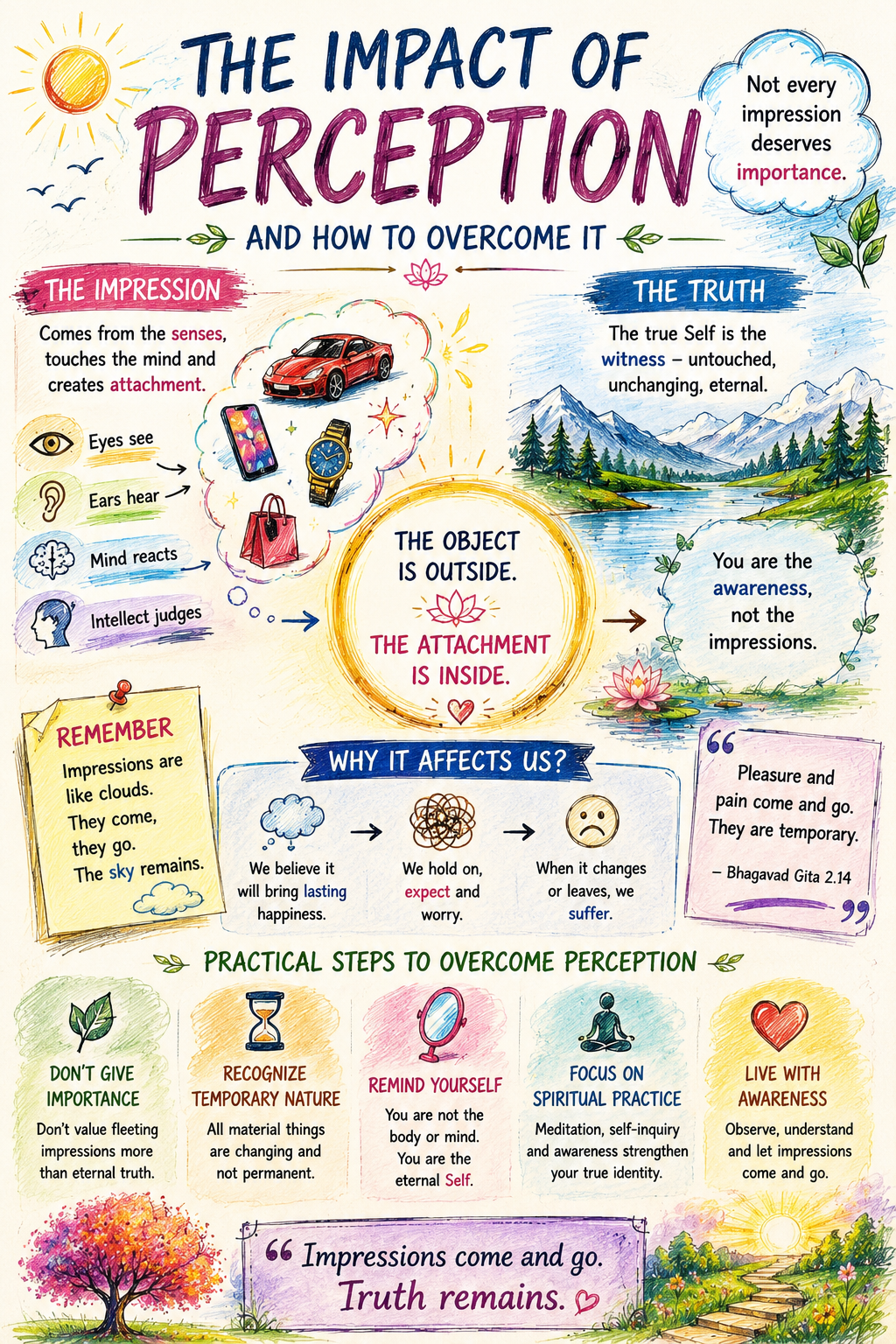
The eyes see an object. The ears hear something appealing. The mind creates a story around it.
Soon the object appears more important than it really is.
We start believing that possessing it will bring lasting happiness.
This is how attachment quietly begins.
Not because the object has power over us, but because we give power to the impression it creates.
The object is outside. The attachment is inside.
Most of the suffering comes not from the object itself, but from the importance we give to it.
What Is Really Being Affected?
Vedic wisdom makes an important distinction.
Perceptions affect the senses, the mind, and the intellect.
They do not affect the true Self.
The eyes see beauty. The ears hear praise. The mind reacts. The intellect judges.
All of this happens within nature.
But your deepest identity is beyond these movements.
The impression belongs to the mind. The awareness that notices the impression remains untouched.
The Bhagavad Gita’s Perspective
Lord Krishna explains that contact between the senses and the world produces experiences of attraction and aversion.
These experiences come and go.
They are temporary by nature.
“The contact of the senses with their objects gives rise to pleasure and pain. They come and go; they are temporary.” (Bhagavad Gita 2.14)
When we forget this truth, temporary impressions begin controlling permanent decisions.
When we remember this truth, impressions lose much of their power.
Not every attraction deserves attention. Not every impression deserves importance.
A Simple Everyday Example
Think about a child crying for a toy.
At that moment, the toy appears extremely important.
The child believes happiness depends on getting it.
A few years later, that same toy sits forgotten in a corner.
What changed?
The toy did not change.
The perception changed.
Many adult attachments work in the same way.
What seems essential today may become insignificant tomorrow.
The Turning Point
Most people try to fight attraction directly.
A deeper approach is to understand its nature.
The moment we see that an impression is temporary, we stop treating it as ultimate truth.
We stop blindly following every desire created by the mind.
Instead of asking, “How can I get this?”
We begin asking, “Why has this become so important to me?”
Freedom begins when we stop giving permanent importance to temporary impressions.
A Lesson from Nature
Clouds pass across the sky every day.
Some are bright. Some are dark. Some appear beautiful.
Yet none of them stay.
The sky allows them to come and go without holding on to any of them.
The mind receives countless impressions in the same way.
Thoughts come. Desires come. Attractions come.
The wise learn to let them pass without giving them unnecessary importance.
Impressions come and go. Truth remains.
When we stop respecting temporary attractions more than eternal truth, something changes.
The mind becomes lighter.
Attachments begin losing their grip.
And we discover a freedom that does not depend on possessing anything.
The world may continue creating impressions, but the one who knows their temporary nature remains free.



No Comments