
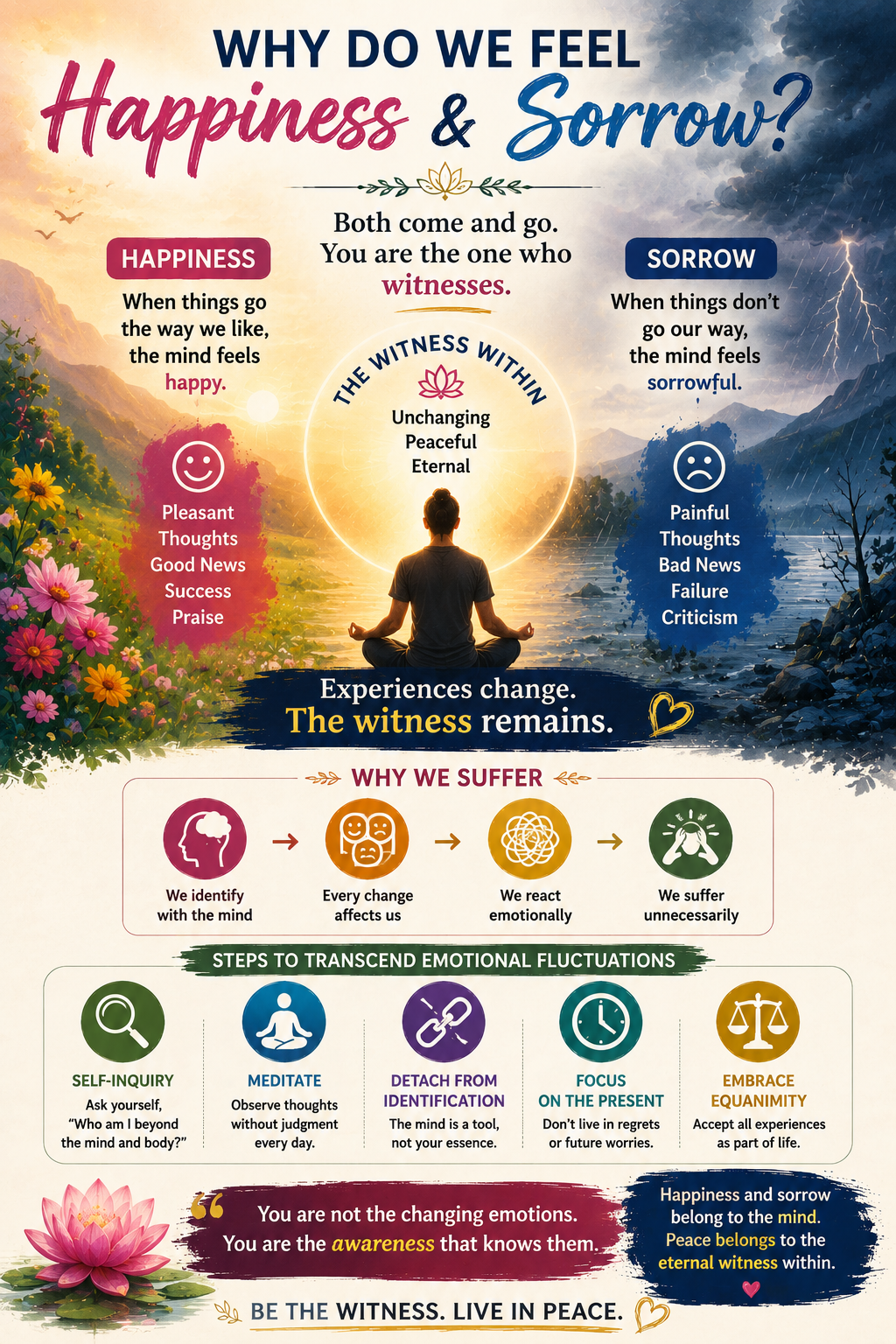
Why do we feel happiness one day and sorrow the next?
A good message arrives and the heart feels light.
A plan fails and suddenly everything feels heavy.
Someone appreciates us and we become joyful.
Someone criticizes us and we become disturbed.
Life appears to move endlessly between pleasure and pain, success and failure, happiness and sorrow.
Most people spend their lives chasing one and escaping the other.
But have you ever wondered who is actually experiencing these changes?
Look carefully.
The happiness you felt last year is gone.
The sorrow that once seemed unbearable has also passed.
Thoughts changed. Circumstances changed. Emotions changed.
Yet something within you remained present through all of it.
That presence witnessed every joy and every disappointment.
Happiness and sorrow come and go. The witness remains.
What Is Really Happening?
According to Vedic wisdom, the mind and intellect are part of nature.
They are instruments, just as the eyes are instruments for seeing and the ears are instruments for hearing.
The mind reacts to situations.
When events match its preferences, it experiences happiness.
When events oppose its preferences, it experiences sorrow.
This movement is natural.
The problem begins when we mistake these reactions for our true identity.
The mind feels sad and we say, “I am sad.”
The mind feels excited and we say, “I am happy.”
Without noticing it, we become identified with every passing emotion.
The experience belongs to the mind, but we mistakenly claim it as our own.
The Wisdom of the Bhagavad Gita
Lord Krishna explains:
“O son of Kunti, the contact of the senses with their objects gives rise to pleasure and pain. They come and go; they are temporary.” (Bhagavad Gita 2.14)
Pleasure and pain are not permanent realities.
They are experiences that arise, stay for a while, and disappear.
The one who observes them is deeper than both.
The mind experiences happiness and sorrow. The soul witnesses both.
Why We Suffer More Than Necessary
Imagine watching a movie.
You may laugh during one scene and cry during another.
Yet somewhere you know that you are not actually inside the movie.
Life is similar.
Experiences come and go across the screen of the mind.
When we forget our deeper nature, we become trapped in every emotional wave.
When we remember our true nature, we begin witnessing those waves instead of drowning in them.
The Turning Point
Most people try to create permanent happiness by changing external circumstances.
But every circumstance eventually changes.
Every achievement fades. Every possession ages. Every experience passes.
This is why lasting peace cannot come from temporary things.
The real turning point comes when we stop asking, “How can I hold on to happiness?”
And start asking, “Who is the one aware of happiness and sorrow?”
The moment we discover the witness within, emotional highs and lows begin losing their power over us.
A Lesson from Nature
The sky remains untouched whether clouds are bright or dark.
Storms may appear. Rain may fall. Sunshine may return.
Yet the sky itself remains unchanged.
In the same way, happiness and sorrow are passing clouds.
Your true nature is the sky.
The clouds move. The witness remains.
You are not the changing emotions. You are the awareness that knows them.
This realization does not remove emotions.
It brings freedom from being controlled by them.
You can enjoy happiness without clinging to it.
You can experience sorrow without being overwhelmed by it.
When we stop identifying with the changing mind and recognize our eternal nature, peace is no longer dependent on circumstances.

No Comments