
The power of Om becomes easier to understand when we stop looking at it only as a sacred word and begin noticing what it reveals about existence itself. Everything around us is moving, changing, appearing and disappearing. Yet there is something deeper that invites us to become quiet and look within.
According to Vedic wisdom, Om, also written as AUM and known as Omkar or Pranava, is regarded as the primordial vibration of existence. It has held a central place in Hindu philosophy, yoga, meditation and Vedantic teachings for thousands of years.
Think of the quietness just before sunrise. For a moment, the world seems still. Then birds begin to call, people start moving, vehicles appear on the roads and the day gradually fills with sound.
By evening, the same movement slowly settles again.
Life moves through these rhythms constantly.
Om gives us a way to become aware of this movement while turning our attention towards the Divine.
Om is not only a sound to repeat. It is an invitation to notice the movement of life and the silence from which it arises.
What Is the Meaning of Om?
Om is traditionally regarded as the primordial sound of existence and one of the most sacred symbols in Hindu spiritual thought. It is associated with creation, consciousness and spiritual awareness.
Ancient teachings describe Om not simply as an ordinary sound, but as a sacred vibration through which existence can be contemplated.
This is why Om appears throughout spiritual practices involving meditation, prayer, mantra and contemplation.
Its meaning becomes more intimate when we look at life itself.
A seed becomes a plant. A plant becomes a tree. A flower appears, blooms and eventually falls. A cloud forms, moves across the sky and disappears. A season arrives and eventually gives way to another.
Nothing in the visible world remains exactly as it is.
Om allows us to observe this changing rhythm without becoming lost in it.
This understanding connects naturally with Understanding Change: The Path to Eternal Truth, where change itself becomes an opportunity to recognise what is deeper than temporary circumstances.
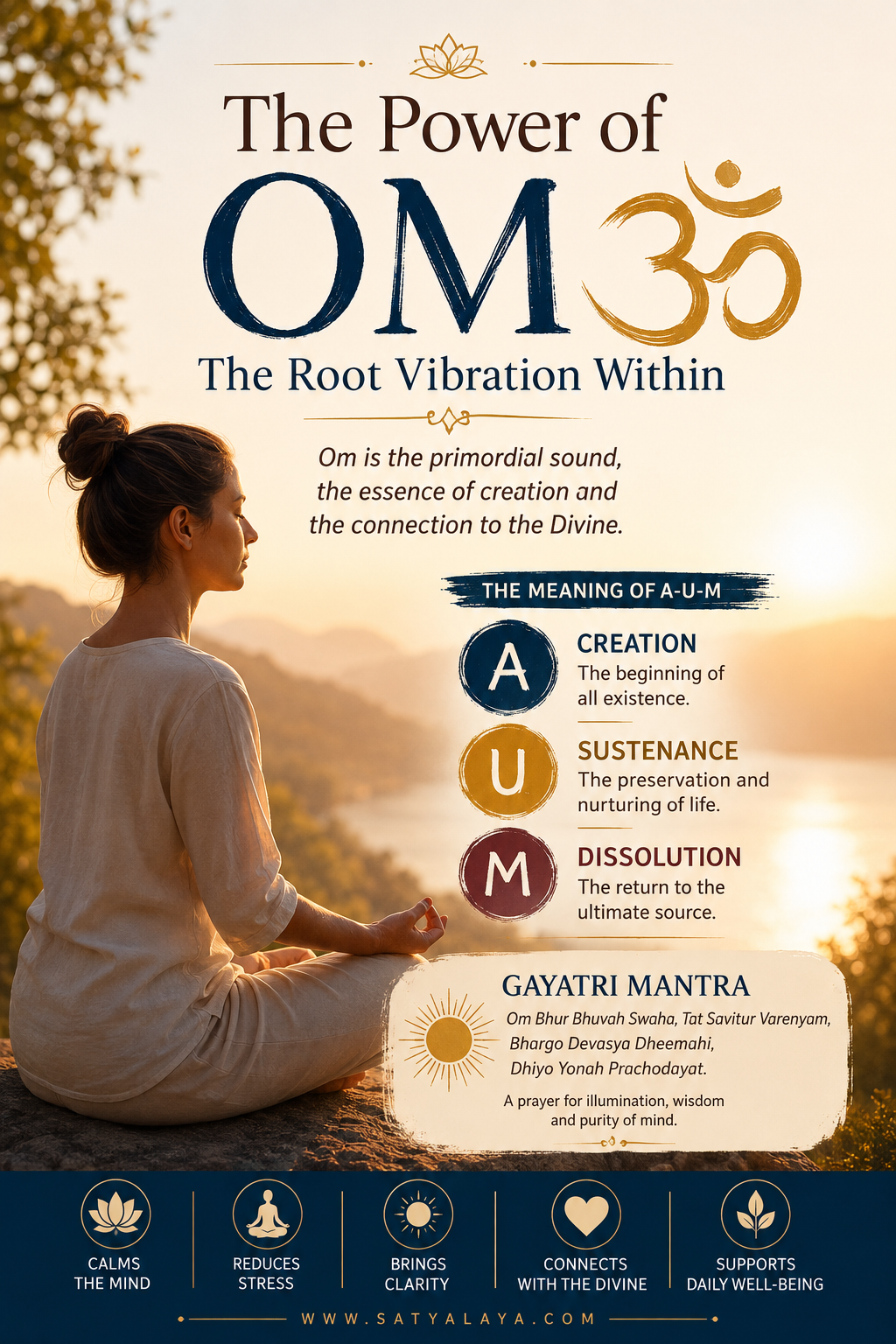
AUM Meaning: A, U and M
Om is traditionally expressed through three sounds: A, U and M.
These three sounds are associated with the movement of existence.
- A represents creation and beginning.
- U represents preservation and continuation.
- M represents dissolution and return to the source.
Together, they point towards a complete cycle.
Something begins.
It continues for a time.
Then it changes and returns.
We can see this rhythm everywhere.
The morning becomes afternoon and then night. A new relationship begins, develops and changes. The body grows, matures and transforms. Even our thoughts appear, remain for a while and disappear.
The source material also connects the three sounds with waking consciousness, dreaming consciousness and deep sleep.
Om is not merely a sound. It is a way of contemplating the different movements of existence and consciousness.
The Silence After Om
Perhaps the most beautiful part of Om is what happens when the sound ends.
The sound begins.
It continues.
It slowly fades.
Then silence remains.
We often pay attention to the sound and immediately move on when it disappears. But the silence afterwards can be equally meaningful.
In spiritual philosophy, this silence is associated with pure awareness — a space beyond constant mental noise and thought. This is one reason Om is traditionally used before meditation, prayer and sacred mantras.
It gives attention an opportunity to move inward.
The same quality of silence can be noticed in ordinary life.
After rainfall, the world can suddenly feel fresh and quiet. Before sunrise, nature rests without effort. After a long conversation ends, there may be a brief moment when nobody feels the need to speak.
Silence does not always mean emptiness.
Sometimes it simply means that nothing more needs to be added.
This connects naturally with Peace Is Already There: Discover It in Silence.
The deeper meaning of Om is not only the sound itself, but the silence that follows it.
Om and Meditation
There are moments when we sit quietly, yet the mind does not become quiet with us.
Thoughts move from one concern to another. Yesterday returns. Tomorrow appears. Something unfinished suddenly becomes important.
Outside, nothing may be happening.
Inside, everything seems to be moving.
This is where Om can become meaningful in meditation.
The purpose is not necessarily to force every thought to disappear. Instead, the sound can give attention something simple and steady to return to.
Chanting Om slowly also brings awareness to the breath. The sound begins with the breath, continues through it and finally fades into silence.
If meditation feels restless, Restless Mind During Meditation explores why stillness can sometimes feel difficult in the beginning.
Sometimes peace is not missing.
It is simply covered by too much inner noise.
This connects with Why Mind Noise Hides Your True Self.
Om and the Gayatri Mantra
The Gayatri Mantra also begins with Om.
Within spiritual practice, Om is traditionally understood as preparing consciousness before the mantra begins, turning attention towards higher awareness and prayer.
The Gayatri Mantra is regarded as a prayer for illumination, wisdom and purification of the intellect.
In this sense, Om becomes more than an opening sound.
It becomes a turning of attention.
From distraction towards awareness.
From outer activity towards inner receptivity.
From restless thought towards remembrance.
Om can become a bridge between the restless mind and higher consciousness.
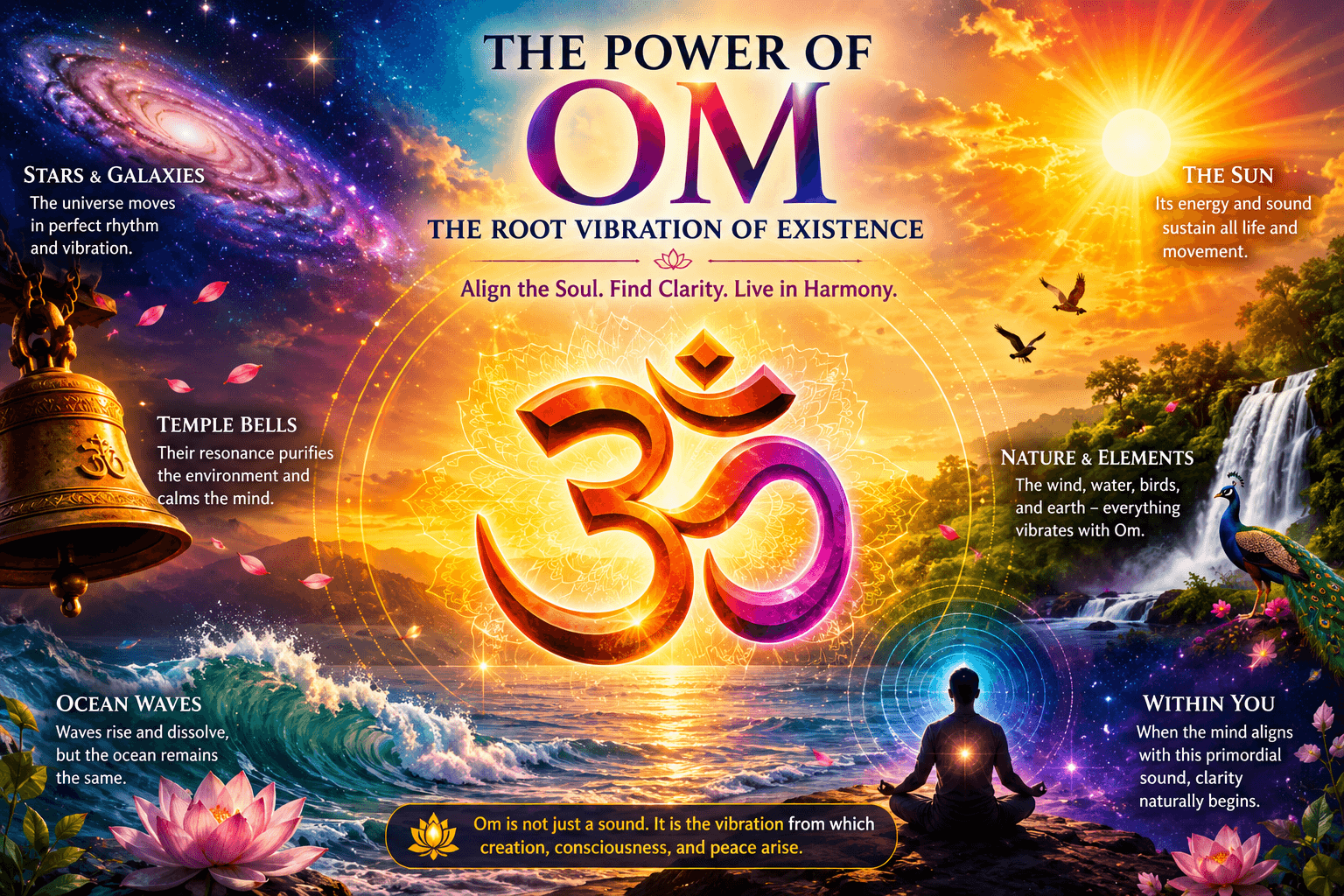
Om and the Rhythm of Nature
Nature reflects the same rhythm found in AUM.
The sun rises and sets.
The moon grows and becomes smaller.
Rivers flow from their source towards the ocean.
Leaves appear and eventually fall.
A tree does not try to hold on to every leaf forever.
It allows one season to become another.
There is something quietly instructive in this.
We often suffer because we expect changing things to remain unchanged. We want relationships to remain exactly as they were, youth to remain, success to continue and comfortable situations never to end.
But change is not an interruption of life.
Change is part of life.
As explored in Time and Body Changes, but Shiva Remains the Same, the changing body and passing time can be contemplated alongside the unchanging Divine.
When We Turn Om Into Another Achievement
Even a spiritual practice can quietly become another form of striving.
We count how many times we have chanted.
We compare our meditation with someone else’s.
We wait for an extraordinary experience.
We wonder whether we are progressing quickly enough.
Something simple can then become complicated.
But Om does not need to become another achievement.
Its beauty can lie in simplicity.
Sit quietly.
Take a natural breath.
Chant Om without hurry.
Listen to the complete sound.
Allow it to disappear.
Then remain with the silence.
Nothing extraordinary has to happen.
Sometimes spiritual practice becomes deeper when we stop trying to make something extraordinary happen.
How to Chant Om Meaningfully
Om can be practiced in a simple and natural way.
Choose a quiet moment in the morning or evening.
Sit comfortably and take a natural breath.
Chant Om slowly and consciously rather than mechanically.
Notice the vibration as the sound moves with the breath.
Listen to the beginning of the sound.
Listen as it continues.
Notice how naturally it fades.
Then do not immediately fill the silence.
Remain quiet for a few breaths.
The source material emphasises this movement from sound into stillness as an important part of the practice.
The purpose is not to escape ordinary life.
It is to return to ordinary life with a little more awareness, gratitude and remembrance.
When Still Water Becomes a Mirror
There is a simple image from nature that helps explain this.
When water is constantly disturbed, its surface cannot clearly reflect what is above it.
But when the water becomes still, the sky begins to appear naturally.
The sky was not created by the stillness.
It was simply easier to see.
Something similar can happen within us.
When constant mental movement settles, awareness may become easier to notice.
This does not mean that every thought must disappear. It simply means we stop being pulled by every thought.
Om can become one gentle way of returning to that stillness.
Om Is More Than a Meditation Technique
It is easy to think of Om only as a breathing or relaxation technique.
But for a devotee, it can become something more intimate.
It can become remembrance of God.
A few repetitions of Om can remind us that life is larger than what we can see, possess or achieve.
A difficult day can become an opportunity for surrender.
A quiet morning can become an opportunity for remembrance.
A moment of uncertainty can become an opportunity to turn inward.
Spiritual practice does not necessarily mean leaving ordinary life behind.
It can change the way ordinary life is seen.
This naturally connects with Naam Jap: Remembrance of God, where remembrance becomes part of everyday living.
For a deeper reflection on devotion, Divine Connection: Love Over Knowledge explores the movement from intellectual understanding towards a more intimate connection with the Divine.
Om and the Divine Presence
The sound of Om arises, continues and dissolves.
The visible world follows a similar pattern.
Forms arise.
Forms change.
Forms disappear.
Yet spiritual life turns our attention towards what is not limited to these changing forms.
For the devotee, this can become a reminder that the Divine is not dependent upon circumstances remaining favourable.
Life takes unexpected turns.
Yet remembrance of God can remain.
This connects with God’s Eternal Presence, a reflection on the Divine presence that remains beyond changing circumstances.
It also points towards Realizing Our True Nature, where the changing surface of experience becomes an invitation to look deeper.
Like a Wave Returning to the Ocean
A wave rises from the ocean.
It moves for a while.
Then it returns to the ocean.
It has a beginning, a movement and an ending, yet it was never separate from the water.
Om offers a beautiful way to contemplate this mystery.
The sound arises.
It moves.
It dissolves.
Silence remains.
Perhaps the deeper message is not about holding on to the sound forever, but about recognising the source to which everything ultimately returns.
The Deeper Meaning of Om
The meaning of Om becomes deeper when we stop limiting it to the moment of chanting.
Its rhythm can be noticed throughout life.
In the beginning of a day.
In the ending of a season.
In the growth and ageing of the body.
In relationships that begin and change.
In success that arrives and eventually passes.
In thoughts that appear and disappear.
Everything visible moves through change.
And perhaps this is why Om has remained so meaningful for generations.
It reminds us to observe the changing forms without forgetting the deeper reality towards which spiritual life turns.
Om therefore need not remain only a sound heard during prayer or meditation.
It can become a way of looking at existence itself.
A Quiet Reflection
The next time you chant Om, listen beyond the sound.
Notice how it begins.
Notice how it continues.
Notice how naturally it disappears.
Then notice the silence that remains.
Later, when you see a flower bloom, a river flow, the sun set or an old leaf fall from a tree, remember the same rhythm.
Life is constantly moving through forms.
Perhaps the deeper spiritual invitation is to participate in life without forgetting what is beyond its changing forms.
Om does not merely ask us to repeat a sound.
It invites us to listen.
To observe.
To become quiet.
And to remember the Divine.
Om begins as a sound, opens into silence, and turns the heart towards the Divine.
The sound changes, the forms change, and life changes — but the silence behind them invites us to remember what is eternal.

No Comments