
Why does the mind become restless about some things but remain completely calm about others?
A delayed text can disturb us for hours.
A small change in someone’s behavior can create anxiety.
A future possibility that has not even happened yet can steal today’s peace.
Fear often appears suddenly.
But if we look carefully, fear rarely arrives alone.
Something is usually standing behind it.
Something we do not immediately notice.
An attachment.
Most people spend their energy fighting fear.
They try to become stronger.
More confident.
More positive.
Yet the fear often returns in a different form.
One fear disappears.
Another takes its place.
The names change.
The feeling remains.
This happens because fear is often not the root.
It is a signal.
A messenger pointing toward something we are holding too tightly.
Fear often reveals where attachment has quietly become dependence.
Consider a few common fears.
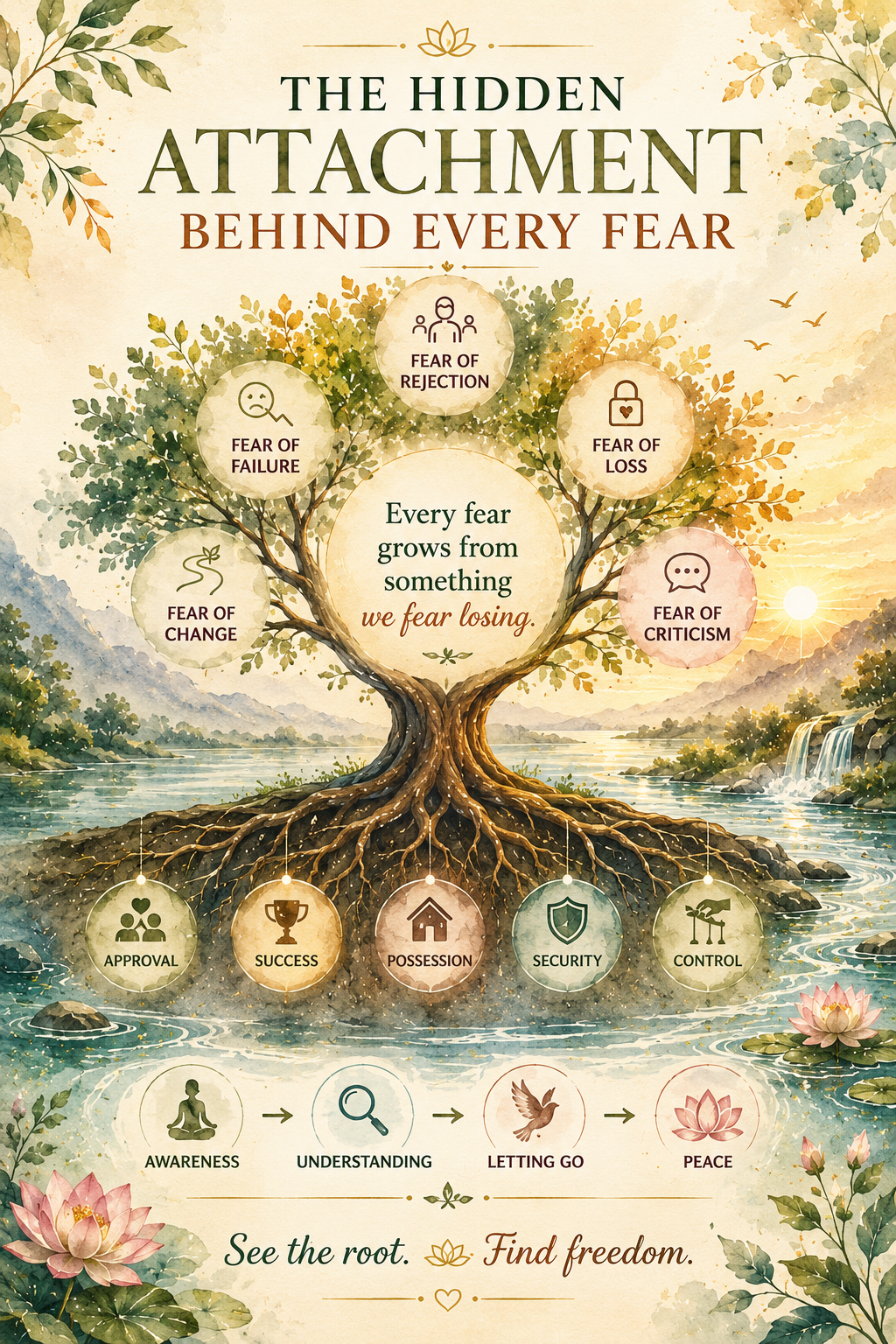
Fear of rejection.
Fear of failure.
Fear of criticism.
Fear of losing money.
Fear of losing control.
On the surface they appear different.
Yet beneath them, a pattern begins to emerge.
The fear of rejection may hide an attachment to approval.
The fear of failure may hide an attachment to success.
The fear of criticism may hide an attachment to image.
The fear of loss may hide an attachment to possession.
The stronger the attachment, the more real the fear feels.
This is why the mind can create fear even when no immediate danger exists, a pattern explored in Why Your Mind Creates Fear Without Reason — And Why It Feels So Real.
What makes this difficult to see is that attachment rarely looks like attachment.
It often looks like love.
Responsibility.
Ambition.
Security.
Planning.
The attachment remains hidden until something threatens it.
Then fear suddenly appears.
The fear is not creating the attachment.
The fear is exposing it.
This deeper pattern can also be seen in Attachment to Temporary Things, where temporary things quietly become the source of our emotional dependence.
A tree teaches a simple lesson.
Every season it lets go of leaves.
It does not resist autumn.
It does not panic when change arrives.
Because its strength is not in what falls away.
Its strength is in what remains rooted.
Human beings often do the opposite.
We build our security around changing things.
Possessions.
Relationships.
Achievements.
Opinions.
And when life begins to move, fear appears.
Not because change is wrong.
But because we expected temporary things to provide permanent security.
Many people experience this same struggle while searching for lasting happiness in changing circumstances, as explored in Chasing Happiness in What Doesn’t Last.
The turning point comes when we stop asking:
“How do I get rid of this fear?”
and begin asking:
“What am I afraid to lose?”
That question changes everything.
Suddenly fear becomes a guide.
Instead of fighting it, we learn from it.
Instead of suppressing it, we observe it.
This shift from reaction to observation is explored further in The Art of Observing Without Reacting.
Every fear contains a hidden lesson about where we have placed our sense of security.
As awareness deepens, something interesting begins to happen.
The attachment may still exist.
The situation may remain unchanged.
Yet the fear starts losing its grip.
Not because life becomes predictable.
But because we stop expecting permanence from things that naturally change.
We begin discovering a quieter place within ourselves.
A place that remains present through gain and loss, success and failure, praise and criticism.
This deeper stability is beautifully reflected in Everything Changes, Awareness Remains Unchanged.
Fear is not always warning us about danger. Sometimes it is revealing where attachment has replaced freedom.
The next time fear appears, there may be no need to push it away.
Pause for a moment.
Look beneath the fear.
Listen carefully.
You may discover that fear is not the real problem.
It is simply pointing toward something you have been holding too tightly.
Every fear hides an attachment. Every attachment points toward a place where greater freedom is waiting to be discovered.
No Comments