
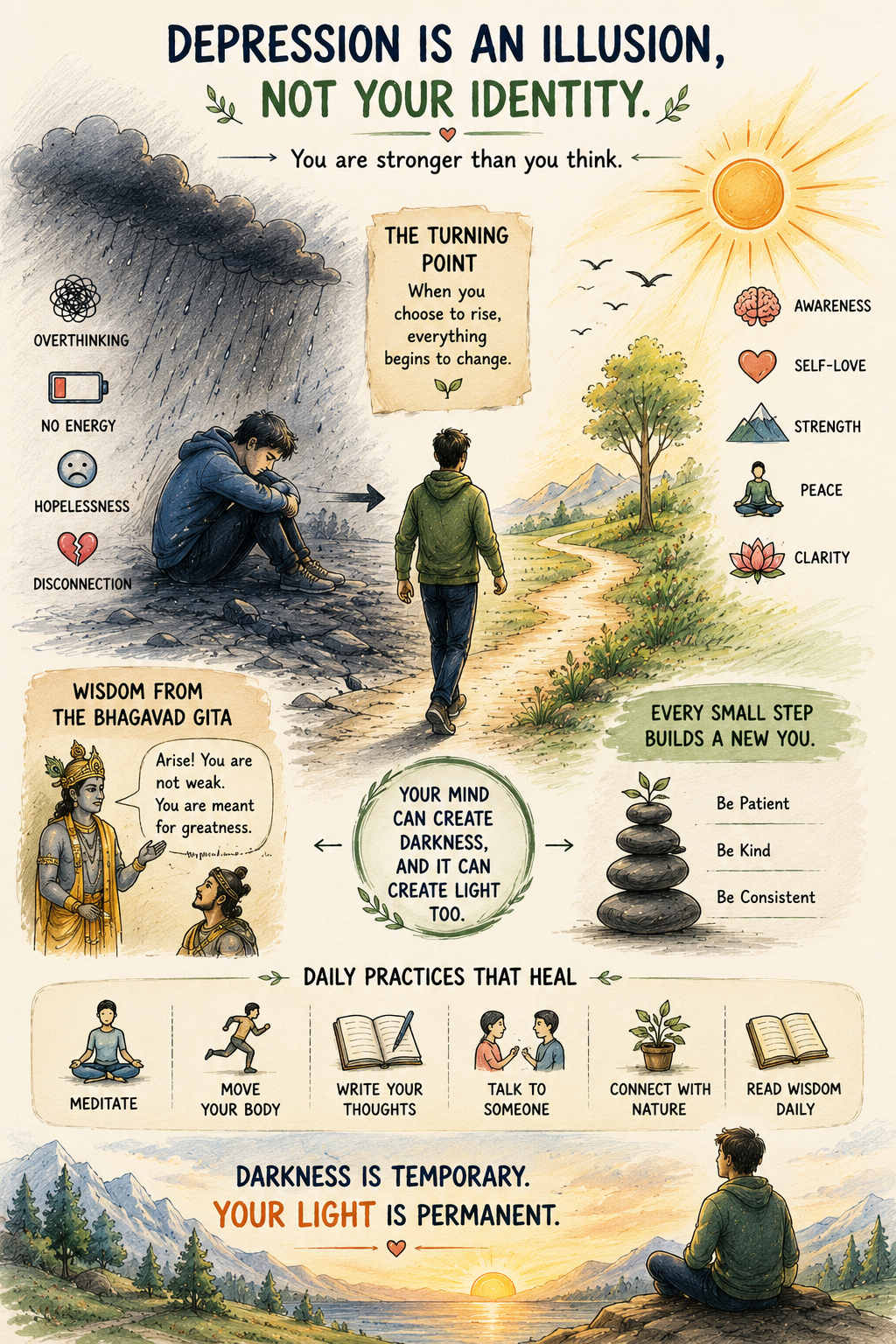
Sometimes depression does not arrive as loud pain. It arrives quietly. A loss of energy. A loss of interest. A strange heaviness that makes even simple things feel difficult.
A person may continue smiling, working, talking, and living normally from outside, while inwardly feeling disconnected from life itself.
This is why depression often feels so confusing. Nothing may look completely wrong externally, yet the mind slowly loses its sense of meaning, movement, and hope.
The mind suffers deeply when it forgets its own inner strength.
Many people think depression is only sadness. But often it is accumulated exhaustion, suppressed emotion, constant comparison, inner conflict, loneliness, fear, system failure and mental overthinking slowly gathering together.
The modern mind rarely rests. It keeps consuming information, worrying about the future, replaying the past, and comparing itself with others. Eventually the nervous system becomes tired.
Even science now shows that prolonged stress and hopeless thinking affect brain chemistry, energy levels, motivation, sleep, and emotional balance.
Negative thinking slowly becomes a habit. And the more the mind repeats darkness, the more real that darkness starts feeling.
The mind begins believing the same thoughts it repeatedly feeds itself.
Ancient spiritual wisdom observed this long before modern psychology. In the Bhagavad Gita, even Arjuna — a powerful warrior — suddenly loses clarity, strength, and the will to act.
His body trembles. His thoughts become confused. His mind becomes overwhelmed by fear and emotional collapse.
“क्लैब्यं मा स्म गमः पार्थ नैतत्त्वय्युपपद्यते। क्षुद्रं हृदयदौर्बल्यं त्यक्त्वोत्तिष्ठ परन्तप॥”
Bhagavad Gita 2.3
Lord Krishna does not condemn Arjuna. He reminds him of something deeper: this weakness is not his true nature.
That insight is important even today. A depressed state may feel permanent, but it is not the complete truth of who someone is.
Many people unknowingly become trapped because they start identifying completely with their mental state.
- “I will never feel normal again.”
- “Nothing will improve.”
- “I am broken.”
- “Life has no meaning now.”
The mind repeats these thoughts so often that they begin feeling absolute. But thoughts are not always reality.
Healing usually does not happen in one dramatic moment. It begins through small shifts repeated consistently.
A little sunlight. A little motivation. A little silence. A little self-honesty. A little connection with life again.
This is why practices like meditation, mindful breathing, prayer, physical activity, nature walks, meaningful conversations, and spiritual reflection can slowly help restore balance.
Not because they magically erase pain overnight, but because they slowly reconnect the mind with stability and awareness.
Hope does not always return loudly. Sometimes it returns quietly through small moments of willingness to continue.
Nature teaches this beautifully. The darkest night never stops the sunrise from arriving. Winter may make trees appear lifeless, yet life quietly continues within them.
Human beings are not different. Even during inner darkness, the possibility of healing still exists silently underneath.
Depression becomes dangerous when a person forgets that their current state is temporary, not their entire identity.



No Comments