
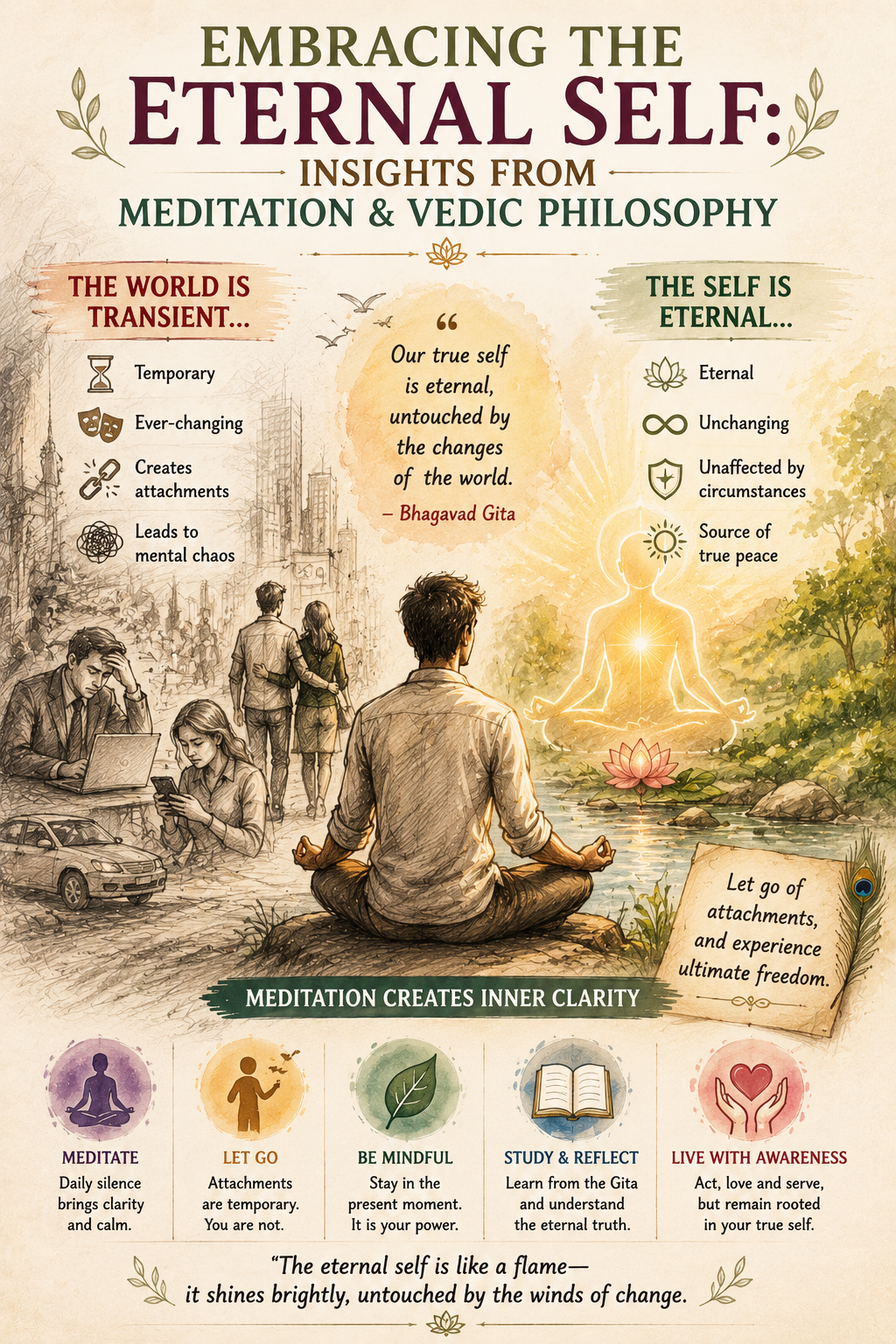
Most mental heaviness does not come from the world itself. It comes from continuous attachment, overthinking, and unconscious with temporary experiences.
The mind keeps holding situations internally long after they have already passed.
One thought creates another.
One fear creates another.
One attachment creates another.
Slowly inner clarity becomes covered.
This is why even in comfortable surroundings many people still feel restless internally.
The deeper problem is not always outside circumstances. Often the disturbance comes from forgetting the eternal nature of consciousness itself.
The mind becomes unstable when it continuously depends on changing things for inner peace.
What constantly changes cannot become the permanent foundation of peace.
Vedic wisdom repeatedly points toward a simple truth:
The world keeps changing.
Experiences keep changing.
Mental states keep changing.
But deeper awareness silently remains present beneath every changing experience.
Most suffering begins when consciousness becomes completely entangled in temporary mental movement and forgets its deeper nature.
Clarity does not arise by controlling every thought. It begins when attachment to every thought slowly reduces.
Meditation becomes powerful not because it forcefully removes thoughts, but because it slowly creates distance between awareness and mental noise.
Then thoughts continue appearing, but consciousness stops becoming fully trapped inside each one.
This inner space itself starts creating peace.
Nature reflects this beautifully. Mud can temporarily disturb the surface of water, yet when movement settles, the water naturally becomes clear again. In the same way, consciousness naturally contains peace beneath mental restlessness.
The turning point comes when a person realizes that spirituality is not escaping life, but understanding its temporary nature correctly.
Situations can still be handled.
Responsibilities can still be fulfilled.
Relationships can still be valued.
But internally there is less unconscious dependence on them for permanent happiness.
Freedom begins when awareness stops trying to hold permanently what life itself keeps changing.
Meditation is not running away from the world. It is returning awareness back toward its original clarity.
Silence, self-awareness, devotion, truthful living, prayer, and conscious observation help because they gradually reduce inner clutter and emotional heaviness.
Then peace stops becoming something searched for externally and slowly starts revealing itself from within.
And perhaps true spiritual clarity begins the moment consciousness realizes that peace was never absent — it was only covered by continuous mental attachment.

No Comments