
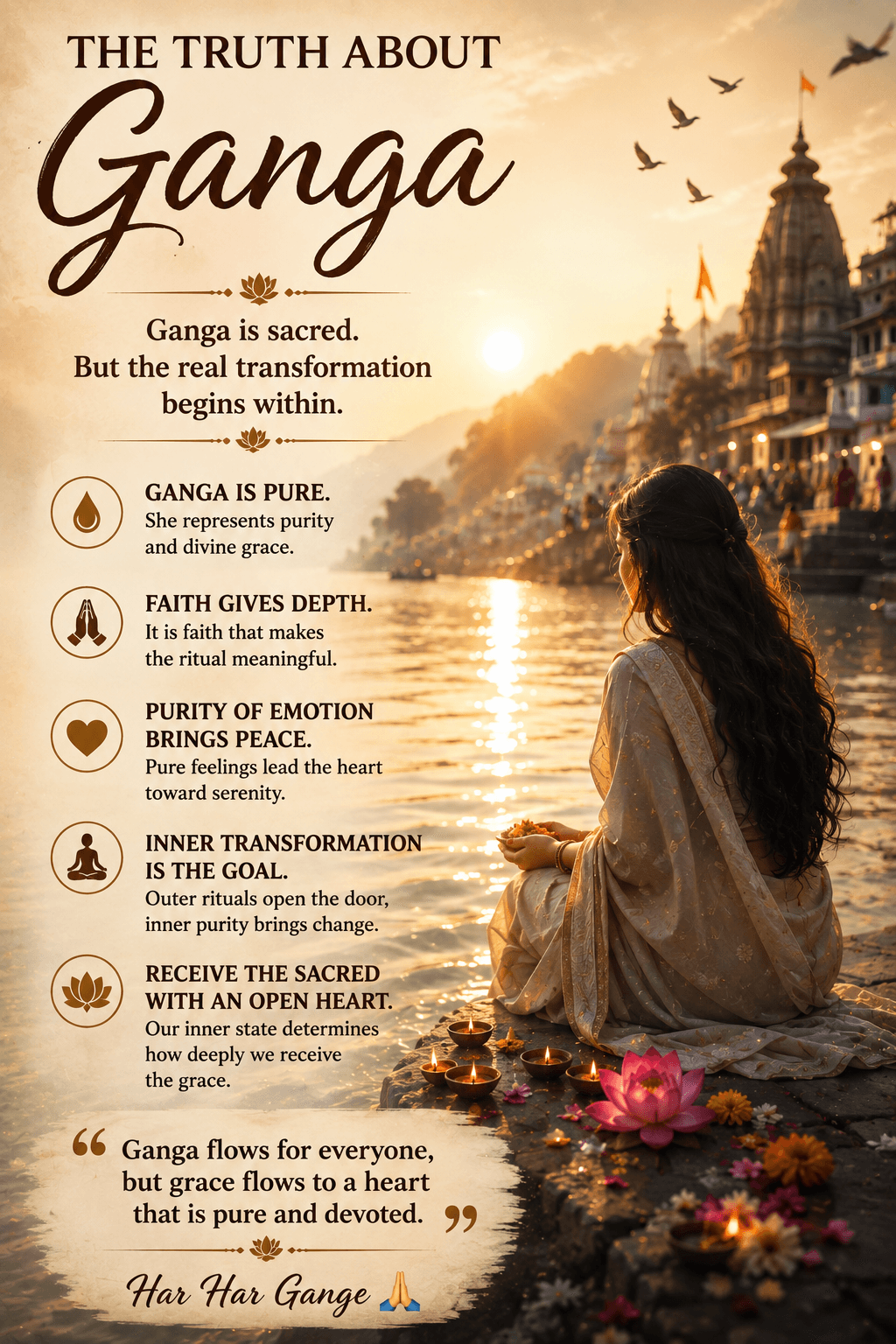
The truth about Ganga and inner purity begins with a simple question: what truly happens within us when we take a holy bath?
For generations, people have travelled to the Ganga with faith, devotion, and a longing for purification. They bow before her, enter the water, offer prayers, and return carrying a sense of something deeply meaningful.
Ganga is revered as sacred and pure. For a devotee, her waters are not merely a physical element but part of a living spiritual tradition that has inspired countless people for centuries.
“Salvation is not in Gangaji; it lies in your inner feeling.”
This thought does not diminish the holiness of Ganga. It points toward something deeper: the way we approach what is sacred also shapes what we carry away from it.
Ganga is pure and sacred. Faith, sincerity, and devotion help us receive the deeper meaning of being in her presence.
More Than a Sacred Bath
A dip in Ganga can be a beautiful expression of faith. It can quiet the mind, soften the emotions, and create a moment in which worldly concerns seem less important.
Yet the significance of that moment does not have to end when we step out of the water.
We can carry its spirit into the way we speak, think, respond, and live.
This is where outer practice and inner life meet. The ritual has its place, while the sincerity behind it gives the moment a personal depth.
Why the Feeling Matters
Imagine two people standing beside the same river.
Both take a bath. Both offer their prayers. Both have travelled to the same place.
Yet one may be absorbed in completing a tradition, while the other may be filled with gratitude, humility, and a longing to come closer to God.
Nothing has changed in the river. What differs is the state in which each person receives the moment.
Sacred places can quiet us and turn our attention inward. As explored in God Is Not Far Away, the Divine is not confined to a particular location. A holy place can help us recognize a presence that is already there.
The holiness of Ganga remains untouched; what changes is how deeply we allow that encounter to influence our lives.
What Happens After the Bath?
Perhaps this is the moment that deserves more attention.
After leaving the river, there can be a quiet pause before returning to ordinary life. Instead of allowing the feeling to disappear with the journey, we can give it a direction.
A simple intention may be enough:
“May I live with greater purity, remember God more sincerely, and carry this feeling into my daily life.”
The words themselves are not the important part. What matters is whether we genuinely wish to live by them.
The water has been received with reverence. Now our actions can reflect what that moment awakened within us.
Intention and Commitment
Intention is the direction we sincerely choose. Commitment is the willingness to remain with it after the moment has passed.
Suppose we leave Ganga wishing to become more patient. The real opportunity appears later, when someone tests that patience.
If we wish to release resentment, the opportunity comes when an old memory returns.
If we wish to remember God more often, we can bring that remembrance into an ordinary morning, a journey to work, or a difficult moment.
In this way, a single moment of devotion can gradually influence the way we live.
When the Outer Form Is Not Enough
Sometimes we become so focused on completing a religious practice that we overlook what it is meant to awaken.
A person may visit many holy places and still struggle with anger. Another may perform countless rituals while remaining deeply attached to recognition, possessions, or old grievances.
This does not make those practices meaningless. It simply reminds us that spiritual life has both an outer expression and an inner movement.
The more meaningful question may not be, “How much have I done?”
It may be, “What is becoming different in me?”
The Turning Point
A pilgrimage can give us a few moments of stillness. The sight of Ganga can fill us with devotion. A prayer can bring an unexpected sense of closeness to God.
Then we return home.
The familiar situations return too.
This is where the deeper value of the journey begins to reveal itself.
Are we a little more patient than before?
Do we hold on to anger for less time?
Can we remember God when circumstances become difficult?
Has gratitude become a little more natural?
These quiet changes may tell us more than the intensity of a single spiritual moment.
Purity is not about creating an appearance of perfection. It is reflected in increasing sincerity, truthfulness, humility, and freedom from unnecessary selfishness.
This connects naturally with The Eternal Purity of Innocence.
A Small Shift in Living
We do not have to wait for another pilgrimage to continue what began beside the river.
A quiet prayer before starting the day can be enough.
A moment of restraint when anger rises can be enough.
Choosing forgiveness instead of carrying an old hurt can be enough.
Remembering God in an ordinary moment can be enough.
Spiritual growth often becomes visible through these small changes rather than dramatic experiences.
Like a River That Keeps Flowing
A river does not need to announce that it is moving. It simply continues its journey.
Perhaps our inner life can unfold in a similar way.
We do not need to constantly measure how spiritual we have become. We can keep moving toward truth, devotion, humility, and God.
One sincere intention can lead to another. One good choice can make the next one easier. Over time, what once required effort can become part of our nature.
A sacred moment becomes deeper when its meaning continues in the way we live.
The Journey Does Not End at the Riverbank
Leaving Ganga does not have to mean leaving behind everything we felt there.
If the visit leaves us more humble, more grateful, less attached, and more drawn toward God, then its influence has travelled home with us.
The deeper spiritual relationship is not about collecting holy experiences. It is about recognizing where we truly belong. This is beautifully expressed in I Belong to God and God Belongs to Me.
The river can become a place of prayer, surrender, and remembrance.
Daily life becomes the place where those qualities are lived.
A Quiet Reflection
The next time you stand before Ganga, perhaps carry one simple question with you:
“Has this journey brought me a little closer to God?”
Not only what happened while you were there, but what remains after you return.
Not only what you felt beside the river, but how that feeling influences the next conversation, the next decision, and the next difficult moment.
Ganga remains sacred and pure. The deeper opportunity is to approach her with faith, receive her grace with humility, and allow that encounter to inspire a more sincere way of living.
We may bow beside the river.
We may bathe in her holy waters.
But the meaning of that moment continues through the life we choose afterward.
Ganga is sacred and pure. Our intention and commitment allow the blessing of that sacred encounter to find expression in everyday life.
The sacred bath may end at the riverbank, but its meaning can continue through the life we live afterward.


No Comments