
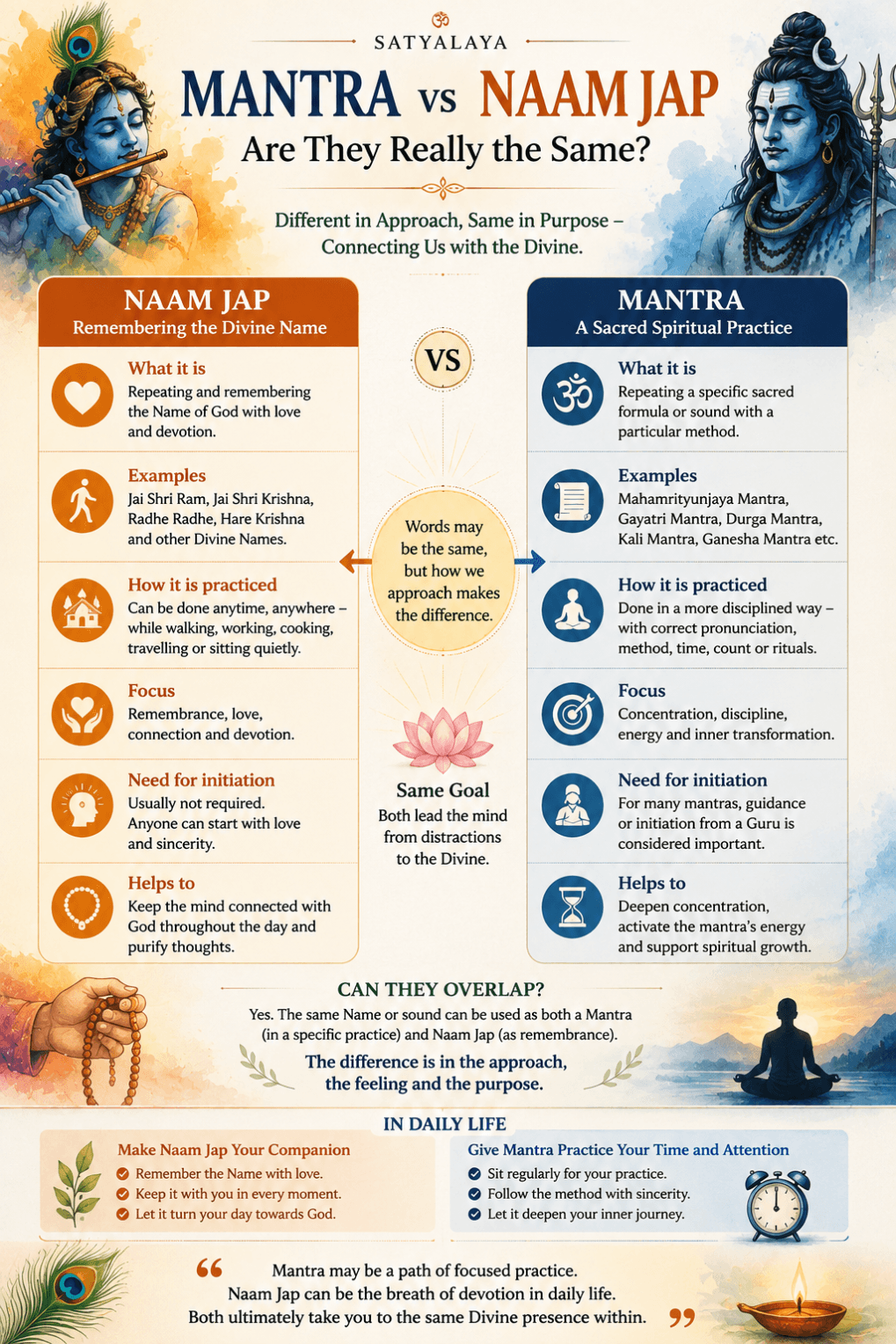
You may say “Jai Shri Ram” while walking, “Radhe Radhe” while doing your work, or sit quietly and recite the Mahamrityunjaya Mantra. All of these involve sacred repetition. But are they really the same?
Mantra and Naam Jap are often used as if they mean exactly the same thing. They are closely connected, but the way they are approached can be quite different.
One may involve a more focused spiritual discipline. The other can become a simple remembrance that quietly stays with you throughout the day.
Mantra vs Naam Jap: What Is the Difference?
Consider a few famous examples.
Jai Shri Ram.
Jai Shri Krishna.
Radhe Radhe.
Hare Krishna.
These can naturally be used for Naam Jap — remembering and repeating the Divine Name with devotion.
Now consider:
Mahamrityunjaya Mantra.
Gayatri Mantra.
Specific Durga or Kali Mantras.
These are specific sacred formulations that may be undertaken as a more deliberate spiritual practice, with attention to pronunciation, method, discipline, and, depending on the tradition, appropriate guidance.
Naam Jap is primarily about remembering the Divine through the Name. Mantra practice is often about consciously practising a particular sacred formula.
What Is Naam Jap?
Naam Jap means repeating and remembering the Divine Name.
It can be very simple.
You may quietly say “Ram” while walking.
You may remember “Krishna” while doing your daily work.
You may say “Radhe Radhe” when your heart naturally turns towards Radha and Krishna.
You may remember “Jai Shri Ram” when you feel disturbed and want to turn your mind towards God.
The beauty of Naam Jap is that it can gradually become part of ordinary life.
Your day does not have to stop for remembrance to begin.
You can walk and remember.
You can work and remember.
You can travel and remember.
You can sit quietly and remember.
You can also explore the deeper meaning of remembering Krishna through His Divine Name in The Significance of Saying Jai Shri Krishna.
Why Naam Jap Is More Than Repeating a Name
Suppose someone says “Ram” one hundred times.
Another person says it only ten times.
Can we say that the first person has necessarily gone deeper?
Not necessarily.
Naam Jap is not simply a race of numbers.
The feeling behind the repetition matters.
A Name repeated mechanically may remain only a sound.
The same Name remembered with devotion can become a turning of the heart towards God.
The lips may repeat the Name, but Naam Jap truly begins when the heart starts remembering.
What Is Mantra?
Mantra is also connected with sacred repetition, but a mantra can be a specific sacred formulation used in a more deliberate spiritual practice.
For example, the Mahamrityunjaya Mantra is traditionally associated with Lord Shiva.
The Gayatri Mantra is another well-known Vedic mantra.
There are also particular mantras associated with Durga, Kali, Ganesha, Lakshmi, Shiva, and other forms of the Divine.
When such a mantra is taken up as a formal practice, the practitioner may give careful attention to pronunciation, concentration, repetition, method, discipline, and other practices prescribed by the relevant tradition.
For some mantras and traditions, guidance or initiation from a Guru may also be important.
The exact requirements are not identical for every mantra, so it is better not to reduce all mantra practices to one fixed set of rules.
Mantra and Naam Jap: A Simple Comparison
| Naam Jap | Mantra Practice |
|---|---|
| Remembering and repeating the Divine Name | Repeating a specific sacred formula |
| Can naturally continue through daily activities | Often approached as a more focused practice |
| Examples: Jai Shri Ram, Jai Shri Krishna, Radhe Radhe | Examples: Mahamrityunjaya, Gayatri, specific Devi Mantras |
| Emphasis on remembrance and devotion | Often greater emphasis on method, attention, and discipline |
| Can be simple and spontaneous | May involve a particular practice according to tradition |
This is only a simple way of understanding the distinction. The two can overlap, and the exact meaning can vary across spiritual traditions.
But What About Om Namah Shivaya?
This is where the distinction becomes interesting.
“Om Namah Shivaya” is widely known as a sacred mantra. But can someone also repeat it as Naam Jap?
The answer depends on how it is being practised.
Someone may sit down and follow a specific practice of repeating “Om Namah Shivaya” with concentration and discipline.
Another devotee may simply remember “Om Namah Shivaya” throughout the day as an expression of devotion to Shiva.
The words are the same.
But the approach can be different.
The difference is not always in the words. Sometimes it is in the way the words are being practised and remembered.
Does Mantra Need More Attention?
Often, yes — particularly when a mantra is being practised as a formal sadhana.
You may sit down at a particular time.
You may maintain a certain discipline.
You may focus carefully on pronunciation and repetition.
You may use a mala.
And depending on the mantra and tradition, you may seek guidance from a Guru.
Discipline can help the mind become steady.
A focused practice can give direction to a mind that is otherwise constantly moving.
But this does not mean Naam Jap is without discipline.
Regularity can also deepen Naam Jap.
You may choose a fixed time each day, use a mala, or simply create a habit of remembering the Divine Name throughout your daily activities.
Then Why Does Naam Jap Feel So Free?
Because remembrance does not always need perfect conditions.
Imagine you are going to work.
You cannot sit down for a formal spiritual practice.
But you can remember:
Jai Shri Ram.
You are cooking.
You can remember:
Radhe Radhe.
You are travelling.
You can remember:
Jai Shri Krishna.
You are having a difficult day.
You can quietly return to the Name.
Nothing special has to happen around you.
The remembrance can happen right where you are.
That simplicity is one of the beautiful aspects of Naam Jap.
What Happens When the Mind Wanders?
The mind will wander.
You begin with “Ram,” and suddenly you are thinking about work.
You return to the Name, and another thought appears.
Then another.
This does not mean the practice has failed.
The important thing is to return.
Again.
And again.
When the mind wanders, do not fight it. Simply bring it back to the Name.
If you have ever wondered why the mind keeps moving even when you want peace, you may also find Why Your Mind Doesn’t Stop and What Actually Brings Peace useful.
Where We Often Miss the Point
Sometimes we turn spiritual practice into another achievement.
We count our repetitions.
We compare our practice with someone else’s.
We become concerned about whether we are doing enough.
We start looking for extraordinary experiences.
And slowly, the practice itself can become another source of pressure.
But the purpose of remembrance is not to create another thing to prove.
It is to turn the mind towards God.
A person can repeat the Name mechanically thousands of times while the mind remains somewhere else.
Another person may say the Name only a few times, but remember God with genuine love.
The deeper question is not only how many times the Name was spoken.
It is whether the heart was turned towards the Divine.
The Turning Point: From Repetition to Remembrance
Perhaps this is the deepest point of the whole discussion.
In the beginning, you may have to make an effort to remember the Name.
You deliberately say:
Ram.
Then again:
Ram.
But with regular practice, something subtle may happen.
You begin remembering without deliberately trying.
The Name comes to mind during a quiet moment.
It appears when you are worried.
It returns when you see something beautiful.
You may find yourself remembering God while doing something completely ordinary.
The repetition has slowly become remembrance.
And remembrance begins to become a relationship.
The goal is not to make the Name pass through your lips endlessly. It is to let remembrance of God gradually enter your heart.
Can You Practise Both?
Certainly.
There is no need to choose one and reject the other.
You may have a regular mantra practice in the morning.
Then, throughout the day, you may naturally remember the Divine Name.
The focused practice can give discipline.
The remembrance can carry devotion into ordinary life.
One can support the other.
The real purpose is not to collect spiritual practices.
It is to become more connected with the Divine.
When devotion becomes more than a formal practice and begins to feel like a living connection with God, it takes on a different depth. You can explore this idea further in The Divine Bond.
If You Want to Begin Naam Jap Today
You do not need to wait for a perfect routine.
Choose a Divine Name that genuinely attracts your heart.
It may be:
Jai Shri Ram.
Jai Shri Krishna.
Radhe Radhe.
Hare Krishna.
Or another Name through which you naturally feel connected to God.
Repeat it quietly.
Do not worry if the mind wanders.
Do not turn it into a competition.
Do not become obsessed with counting.
Simply return to the Name.
With time, the practice may become less about making an effort to remember and more about naturally remembering.
Mantra or Naam Jap: Which Is Better?
Perhaps this is not the right question.
A better question is:
Which practice is helping my mind turn towards God with greater sincerity and devotion?
For one person, a disciplined mantra practice may become a deep spiritual path.
For another, simply remembering “Ram” throughout the day may become the doorway through which devotion grows.
What matters is not merely the sound.
What matters is what the remembrance is doing within you.
Final Reflection
Mantra can teach us attention.
Naam Jap can teach us remembrance.
A formal practice can bring discipline.
A Divine Name can accompany us through ordinary life.
And eventually, perhaps the distinction becomes less important.
Because the deeper purpose of both is to turn the mind away from constant worldly movement and towards the Divine.
Mantra may be something you consciously practise. Naam Jap can become something you naturally remember. But the real transformation begins when the Name moves from the lips towards the heart.
You do not always need a special place to remember God.
Sometimes, you only need a moment of sincerity.


No Comments