
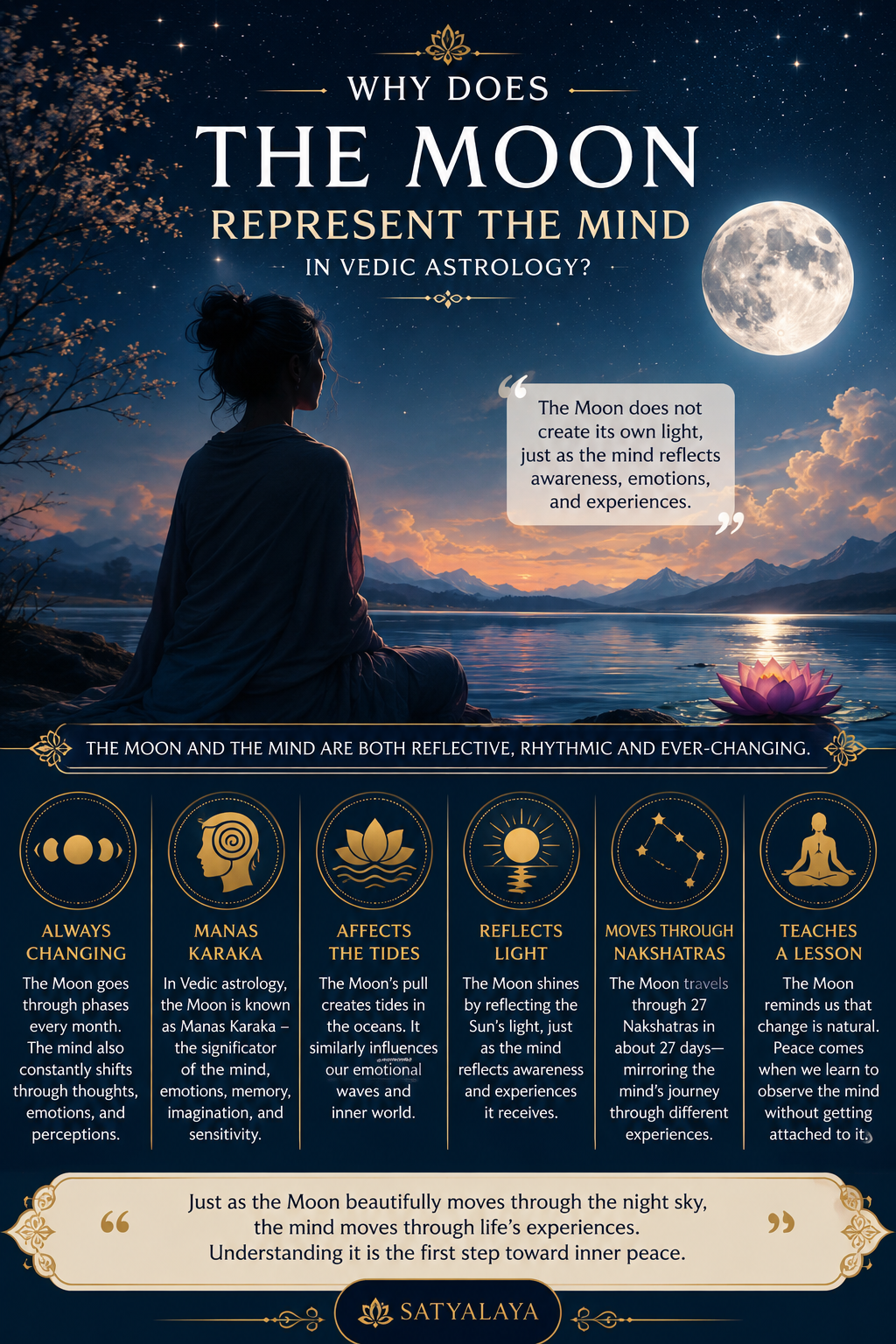
At first, it may seem like a poetic symbol, but the deeper we observe nature, the more meaningful this connection becomes. Ancient Vedic sages did not choose the Moon randomly. They spent generations studying the rhythms of the universe and discovered that the Moon behaves remarkably like the human mind—constantly changing, quietly reflective, and deeply connected with the cycles of life.
In Vedic astrology, every graha represents a universal principle rather than simply predicting events. The Moon, known as Chandra, is called the Mana Karaka, the significator of the mind. It symbolizes our emotions, imagination, memory, intuition, sensitivity, and the way we experience life from within.
Why Ancient Sages Chose the Moon
Among all celestial bodies visible to the naked eye, the Moon displays the most noticeable rhythm of change. It waxes and wanes, disappears into darkness, and returns in full brilliance every month. The sages recognized that the human mind follows a similar rhythm. Thoughts change, emotions rise and fall, confidence turns into doubt, and sadness gives way to hope. The Moon became the perfect symbol because both share the same ever-changing nature.
The Moon was chosen to represent the mind because both are reflective, rhythmic, and constantly changing.
Chandra: The Manas Karaka
Unlike Mercury, which represents intellect and reasoning, the Moon governs our emotional world. It influences how we feel, remember experiences, build relationships, and respond to life’s situations. For this reason, Vedic astrology considers a balanced Moon essential for inner peace and emotional stability.
- Emotional balance
- Mental peace
- Memory and imagination
- Compassion and empathy
- Intuition
- Sensitivity
- Nurturing qualities
The Moon Reflects Light, Just as the Mind Reflects Awareness
One of the most profound reasons the Moon symbolizes the mind is that it produces no light of its own. It shines only by reflecting the light of the Sun. Ancient Vedic thinkers saw this as a beautiful metaphor for human consciousness.
The mind does not create awareness; it reflects it. Just as a mirror reflects whatever stands before it, the mind reflects thoughts, emotions, memories, and experiences. When it is calm, it reflects reality clearly. When disturbed by fear, attachment, or anger, it creates a distorted picture of the world.
The Moon reflects sunlight. The mind reflects awareness.
The Moon’s Phases Mirror the Human Mind
Every month the Moon moves through New Moon, Crescent, Quarter, Gibbous, and Full Moon before beginning the cycle again. These changing phases reminded ancient sages that nothing in nature remains fixed.
Our thoughts also move through different phases. Happiness, sadness, excitement, fear, clarity, and confusion appear and disappear just like the Moon’s changing face. Understanding this simple truth helps us avoid identifying ourselves with temporary emotions.
No phase of the Moon lasts forever, and neither does any state of mind.
The Moon and Water
Modern science confirms that the Moon’s gravitational pull influences the tides of Earth’s oceans. Ancient Vedic sages observed this relationship long before modern astronomy explained it. Inspired by this natural rhythm, they compared the emotional nature of the mind to the movement of water.
Like the sea, the mind is never completely still. Thoughts rise like waves and eventually return to calmness. Fighting every emotional wave creates suffering, while understanding its natural rhythm brings acceptance and peace.
The ocean does not resist its tides, and the mind need not resist every passing emotion.
The Journey Through the 27 Nakshatras
An important feature of Vedic astrology is the Moon’s journey through the twenty-seven Nakshatras. Completing this cycle in approximately 27.3 days, the Moon symbolizes continuous movement and transformation.
Each Nakshatra represents a unique quality of nature. Together they remind us that the human mind also experiences countless emotional and psychological states throughout life. Growth comes not by avoiding these experiences but by understanding them.
The Moon in Vedic Wisdom
The Vedas, Upanishads, and Puranas frequently refer to Chandra as a symbol of nourishment, calmness, beauty, and rhythm. Rather than being worshipped only as a celestial body, the Moon became a reminder of the inner world and its changing nature.
Across Vedic literature, the Moon teaches that observing the mind is the beginning of self-understanding.
The Moon in Ayurveda
Ayurveda also associates the Moon with cooling energy, restoration, nourishment, and emotional balance. While the Sun symbolizes activity and transformation, the Moon represents rest, recovery, and harmony.
This complementary relationship reflects an important principle of life: growth requires both action and stillness. Just as the body needs rest after work, the mind also needs moments of silence to regain clarity.
Science Meets Symbolism
Astronomy explains that the Moon is Earth’s only natural satellite, reflecting sunlight and completing an orbit in about 27.3 days. Vedic wisdom does not attempt to replace these scientific facts. Instead, it uses them symbolically to help us understand ourselves.
Science describes how the Moon moves through space. Vedic philosophy explores what those movements can teach us about the rhythm of the human mind.
What the Moon Teaches Us
The Moon never struggles to remain full, nor does it fear becoming invisible during the New Moon. It simply follows its natural cycle without resistance. Perhaps this is the deepest lesson hidden in its symbolism.
Life also moves through seasons of growth, uncertainty, joy, reflection, and renewal. Peace does not come from preventing change but from learning to observe it with patience and awareness.
Nature never rushes its cycles. The Moon reminds us that inner growth unfolds with the same quiet patience.
Final Reflection
For thousands of years, the Moon has inspired Vedic sages not because it predicts the future, but because it mirrors the inner world. Its changing phases remind us that thoughts and emotions are temporary, while awareness quietly remains. The more we learn from the Moon, the more we understand the nature of our own mind.
The Moon changes every night, yet it never loses its place in the sky. The mind changes every moment, yet peace is found when we learn to observe those changes without becoming lost in them.
No Comments