

Why My Thought Feels Not Belong to Me
Have you ever felt like your own mind is working against you?
Out of nowhere, it shows thoughts, images, or memories you don’t like… sometimes things you strongly disagree with or even fear.
And the more you try to push them away, the more they seem to return.
If this has ever happened to you, pause for a moment and understand this deeply:
These thoughts are not a reflection of who you are.
Why This Feels So Disturbing
This is where most people get stuck.
It’s not just the thought that hurts — it’s what the thought makes you feel.
Confusion. Fear. Self-doubt.
And slowly, you start questioning yourself.
What Are Unwanted Thoughts?
Unwanted thoughts are simply mental events that appear on their own. You don’t invite them. You don’t choose them. They just show up.
You may find yourself asking:
- “Why did this come to my mind?”
- “Does this say something about me?”
- “Why can’t I stop this?”
A thought is just a thought — not a fact, not a decision, and not your identity.
Key Insight
Not every thought deserves your attention. Most thoughts are simply mental noise.
Why Does the Mind Show What You Don’t Like?
The mind is always scanning, predicting, and trying to protect you.
It focuses more on what feels important or uncomfortable.
But sometimes, this system becomes overactive.
Repeating uncomfortable thoughts
Giving them unnecessary importance
Pulling your attention again and again
The Loop You Need to Understand
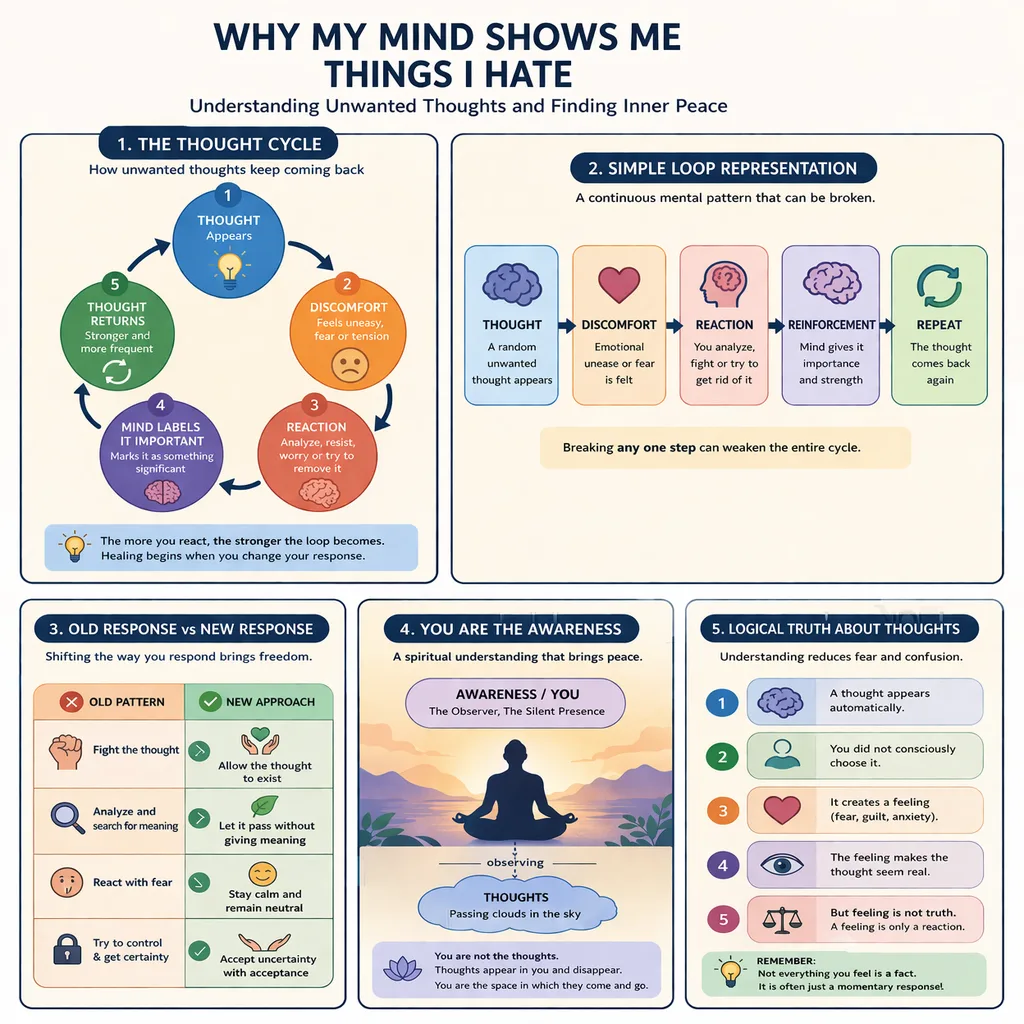
Thought → Discomfort → Reaction → Reinforcement → Repeat
This loop continues not because the thought is powerful…
…but because the reaction is.
The more you react to a thought, the more it repeats
Why These Thoughts Feel So Real
When a thought creates discomfort, your brain assumes:
“This must be important.”
So it keeps bringing it back.
What you repeatedly react to becomes stronger in your mind.
What Most People Do Wrong
- They try to fight the thought
- They try to control the mind
- They over-analyze everything
And unknowingly, they make the loop stronger.
A Deeper Understanding: You Are Not the Mind
Ancient wisdom from the Bhagavad Gita reminds us:
You are the observer of your thoughts, not the thoughts themselves.
You are not your thoughts. You are the awareness behind them.
- You can notice a thought without becoming it
- You can experience it without reacting
- You can let it pass without fear
What Actually Helps (Simple and Practical)
Healing does not come from controlling every thought.
It comes from changing your response.
1. Don’t Fight the Thought
Trying to remove it gives it importance. Let it be there.
2. Don’t Try to Solve It
You don’t need to figure out every thought.
3. Allow the Feeling
Discomfort is temporary. Let it pass.
4. Gently Shift Your Attention
Return to your breath, your work, or your surroundings.
5. Reduce Reaction Gradually
Less reaction = less power.
Take a slow breath. Notice your thoughts… and let them pass.
You Are Not a Bad Person
One of the deepest pains of these thoughts is self-doubt.
Your thoughts do not define your character. Your actions and intentions do.
If a thought disturbs you, it reflects your values — not your identity.
Finding Peace with Your Mind
Peace is not about having no thoughts.
It is about not being controlled by them.
When you stop resisting and start observing… your mind slowly becomes lighter.
Peace begins when you stop being afraid of your own thoughts.
Final Reflection
If your mind shows you things you don’t like, it does not mean something is wrong with you.
It simply means your mind is active.
And it can be understood.
And slowly… it can become calm.
You are not your thoughts. You are the one who notices them.



No Comments