
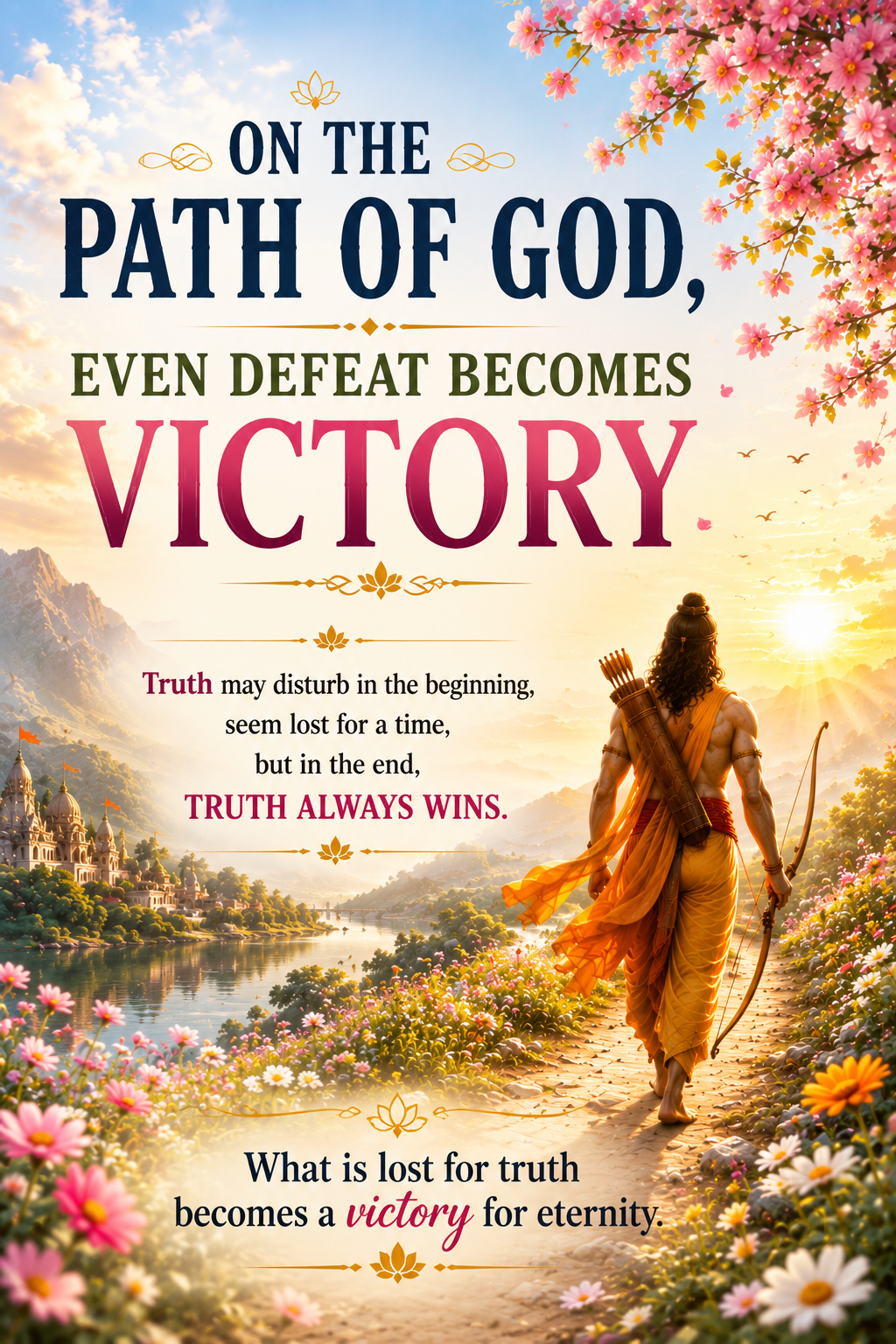
On the Path of God, Even Defeat Becomes Victory
There are moments in life when doing the right thing seems to bring difficulties instead of rewards.
An honest person loses an opportunity.
A truthful person faces opposition.
Someone who keeps their word suffers inconvenience.
A person working for the welfare of other receives little recognition.
In such moments, it is natural to wonder:
Why does the path of truth sometimes seem harder than the path of compromise?
Why do those who remain honest sometimes appear to lose?
The answer begins with understanding what kind of loss we are talking about.
Not every loss is a spiritual victory.
The loss spoken of here is different.
It is the hardship that comes from protecting truth.
It is the sacrifice that comes from choosing justice.
It is the difficulty that arises when morality becomes more important than personal gain.
It is the cost of remaining kind when selfishness would be easier.
It is the price of keeping one’s word when breaking it would be more convenient.
Such losses may appear painful in the moment.
Yet they reveal something beautiful.
They reveal that a person has refused to abandon what is right.
The path of God is not tested when life is easy. It is tested when truth becomes difficult.
The path of God is the path of truth, justice, kindness, selflessness, and the welfare of all.
Anyone can follow these values when circumstances are favorable.
The real test comes when they demand sacrifice.
The real test comes when comfort stands on one side and righteousness stands on the other.
That is where character is revealed.
That is where dharma becomes visible.
Standing for what is right is not always comfortable, yet the deeper value of righteousness becomes clear through The Power of Justice.
The Ramayana offers a profound example of this truth.
Lord Rama was the rightful heir to the throne of Ayodhya.
A life of royal comfort and honor stood before Him.
Yet because of a promise given by King Dasharatha, Lord Rama accepted fourteen years of exile.
He could have chosen comfort.
He could have chosen power.
He could have insisted upon His rights.
Instead, He chose dharma.
He chose to protect the truth of His father’s word.
He chose righteousness over personal gain.
To many, this appeared to be a loss.
A prince left the palace and entered the forest.
A future king became an exile.
But Lord Rama never abandoned truth for comfort.
He never abandoned dharma for convenience.
What appears to be a loss in the eyes of the world can become a victory when it is accepted for the sake of truth.
In the Ramayana, Lord Rama represents truth, righteousness, compassion, and dharma.
Ravana represents ego, arrogance, attachment, and the misuse of power.
For a period of time, Ravana appeared powerful.
He possessed wealth, influence, knowledge, and authority.
Yet power without righteousness cannot remain stable forever.
Lord Rama remained established in truth even during hardship.
Time eventually revealed the difference.
The victory of Lord Rama did not begin on the battlefield.
It began the moment He chose dharma over personal advantage.
Truth often appears weak when compared to immediate success, but appearances can be misleading. As explored in Truth vs Falsehood: Which Has Real Strength?, falsehood may create temporary advantages, but it lacks the stability that truth naturally possesses.
The same principle appears in everyday life.
A person may lose profit because they refuse to cheat.
A person may lose an opportunity because they refuse to lie.
A person may face criticism because they stand for justice.
A person may sacrifice personal gain for the welfare of others.
To the world, these situations may look like defeats.
Yet something precious has been preserved.
Integrity.
Trust.
Character.
Humanity.
These are victories that cannot be purchased.
Sometimes people gain temporary comfort through unfair means.
Sometimes people acquire profit through deception.
Sometimes success appears to come quickly when morality is compromised.
Such gains may look attractive for a while.
But what is disconnected from truth cannot provide lasting peace.
What is built upon selfishness eventually weakens.
What is built upon righteousness becomes stable.
Truth may move slowly, but it moves firmly.
This is why circumstances may change, opinions may change, and situations may rise and fall, yet truth remains the same in the end. What is rooted in truth continues to stand even when everything else changes.
The turning point comes when we stop asking:
“What did I lose?”
and begin asking:
“What did I protect?”
Did I protect truth?
Did I protect justice?
Did I protect kindness?
Did I keep my word?
Did I act for the welfare of others?
If the answer is yes, then the apparent defeat may not be a defeat at all.
It may be a victory hidden beneath temporary hardship.
Dharma may demand sacrifice, but it never leaves a person empty. What is lost for truth eventually becomes a victory far greater than what was given up.
The path of God is the path of truth, justice, kindness, selflessness, and the welfare of all. Those who remain faithful to these values may face temporary hardships, just as Lord Rama accepted exile to protect dharma. Yet what is protected by righteousness is never truly lost. Truth may disturb life in the beginning. It may seem slower, harder, and even appear defeated for a time. But this is a universal law: truth ultimately prevails. What is gained through deception is temporary, while what is built upon truth endures. On the path of God, even defeat becomes victory because truth carries a strength that time itself cannot destroy.

No Comments