
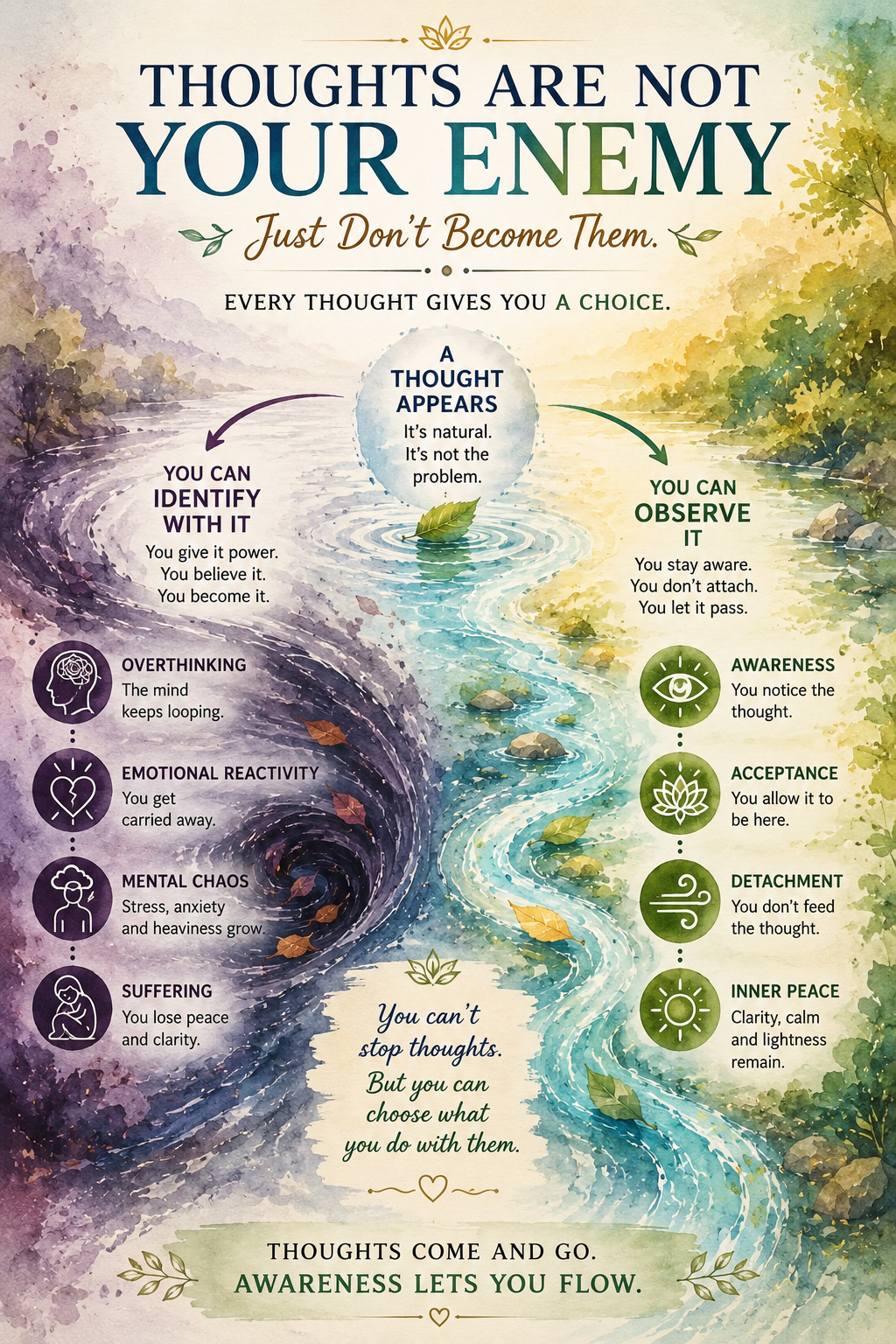
Have you ever noticed how a random thought can change the entire direction of your day?
You wake up feeling fine. Then a thought appears.
“What if something goes wrong?”
“What if they don’t like me?”
“What if I fail?”
Within minutes, the body becomes tense, the mind becomes restless, and a problem that did not exist a few moments ago suddenly feels real.
Most people spend years trying to stop thoughts.
They try to control them, suppress them, replace them, or escape from them.
Yet the harder they fight, the more exhausted they become.
Perhaps the problem is not the thought itself.
Perhaps the problem begins when we become the thought.
Thoughts are natural.
Just as clouds move across the sky, thoughts move through the mind.
Some are pleasant.
Some are disturbing.
Some are wise.
Some are completely meaningless.
Their nature is to come and go.
Yet we rarely allow them to do that.
A thought appears, and immediately we hold it.
We argue with it.
We believe it.
We fear it.
Before long, we are no longer observing the thought.
We have become it.
A thought becomes an obstacle only when awareness forgets itself and becomes the thought.
This happens more often than we realize.
A passing thought says,
“I am not good enough.”
Instead of seeing it as a temporary mental movement, we begin carrying it as an identity.
A passing thought says,
“Something bad might happen.”
Instead of observing it, we start living inside an imagined future.
The thought was temporary.
The identification made it heavy.
Someone speaks a careless word.
The event lasts a few seconds.
Yet the mind may replay it for days.
The original event is gone.
What remains is our attachment to the thought.
The struggle is no longer with reality.
It is with the story we continue carrying.
For a deeper look at this, you may enjoy reading The Hidden Trap of Overthinking and Why Your Thoughts Don’t Feel Like Yours.
Many people assume peace will come when unwanted thoughts disappear.
Yet experience shows something different.
The mind has always produced thoughts.
It did so yesterday.
It will do so tomorrow.
Trying to force silence often creates even more noise.
The deeper shift happens when we stop treating every thought as a command.
Not every thought deserves belief.
Not every thought deserves fear.
Not every thought deserves a reaction.
Some thoughts simply deserve observation.
This simple understanding is closely connected with Why Trying to Control Your Mind Doesn’t Work.
Freedom is not found by stopping every thought. Freedom is found by remembering that you are the observer, not the thought.
Imagine sitting beside a river.
Leaves float past on the water.
You do not jump into the river for every leaf that passes.
You simply watch.
Thoughts can be approached in the same way.
They arrive.
They stay for a while.
They move on.
The difficulty begins when we chase every leaf downstream.
Soon we are exhausted, not because of the river, but because of our attachment to every passing movement.
A powerful turning point comes when we stop asking,
“How do I get rid of this thought?”
and begin asking,
“Who is aware of this thought?”
Attention shifts from the content of the mind to the awareness that notices it.
And in that shift, something becomes surprisingly clear.
Thoughts come and go.
Awareness remains.
Thoughts change.
Awareness remains.
Thoughts are restless.
Awareness remains untouched.
This insight is explored beautifully in Awareness: The Silent Power That Changes Everything and The Art of Observing Without Reacting.
The mind is not your enemy.
Thoughts are not your enemy.
Many thoughts are simply revealing hidden fears, attachments, desires, and assumptions that were already present.
In that sense, they can become teachers.
They show us where we are attached.
They show us what we fear losing.
They show us what still controls us.
Seen clearly, even difficult thoughts can become opportunities for understanding.
The moment awareness returns, the thought loses its power to define us.
Thoughts are not your enemy. They become obstacles only when you mistake them for yourself.
The next time a troubling thought appears, there may be no need to fight it.
Notice it.
Allow it.
Learn from it.
But do not become it.
That simple difference can change the entire experience of the mind.
The mind may produce thousands of thoughts, but peace begins the moment awareness remembers it is larger than every one of them.
Continue exploring:


No Comments