

It was a small moment… so why is it still in your mind?
Why You Overthink Small Things So Much
Sometimes it’s just a small situation—a conversation, a message, a mistake. But instead of passing, it stays in your mind. You replay it again and again, thinking what you could have said or done differently. The situation is over, but something inside keeps returning to it.
It’s not the situation that stays… it’s the mind that keeps going back to it.
Why this happens
The mind tends to hold onto anything that feels incomplete or unclear. One thought leads to another, and slowly it becomes a loop. The more it is revisited, the stronger it feels.From a scientific view, the brain tries to resolve uncertainty. It keeps analysing past moments to avoid mistakes in the future. But instead of solving, it often creates more thinking.
The more a thought is revisited, the stronger it feels.
Pause and reflect
Is the situation still happening, or is it only in the mind?Does thinking more change anything, or only extend the feeling?What happens if the thought comes… and is not continued?Is the problem outside… or inside the repetition?
What goes wrong
Overthinking grows when every thought is taken seriously. The mind creates possibilities, doubts, and imagined outcomes. When these are followed, they form a chain.Trying to mentally solve everything creates more complexity and mental fatigue.
Real-life example
You send a message and don’t get a reply. The mind starts creating stories—maybe something is wrong, maybe you said something incorrect.Or after a conversation, you keep replaying it again and again. The situation has ended, but the mind continues it.
A simple way to see it
It is like scratching a small wound repeatedly. If left alone, it heals. But if touched again and again, it takes longer.In the same way, a small thought fades naturally unless it is continuously revisited.
What you keep touching… stays longer.
What actually helps when overthinking is strong
When overthinking becomes intense, simply trying to stop thinking does not work. The loop is already active. So the first step is not control, but calming the system.
Start with the body. Take a short walk for 10–15 minutes. Slow your breathing—inhale for 4 seconds and exhale for 6. Reduce stimulation by stepping away from constant input. When the body settles, the mind becomes less reactive.
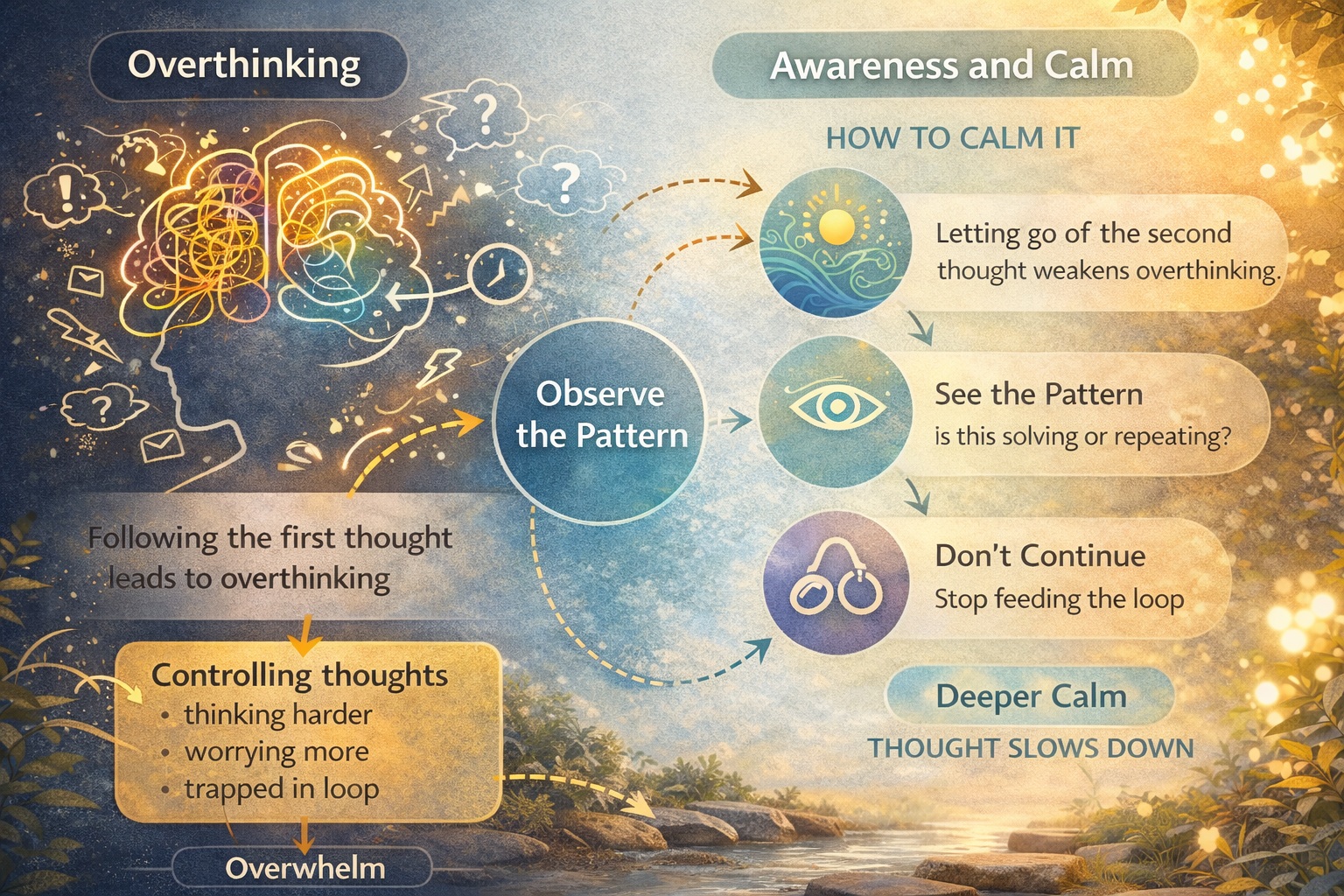
Then shift attention from the story to the pattern. Notice how one thought leads to another. This creates distance.
Now comes the real shift—do not continue the chain. A thought may appear, but it does not need to be extended.
You may not be able to stop the first thought, but you can stop the second.
Small changes like reducing checking, avoiding over-analysis, and allowing space without reacting help weaken the loop.
Overthinking is not many thoughts—it is one thought continued again and again.
Spiritual insight
Peace is not created by solving every thought. It becomes visible when unnecessary thinking slows down. Thoughts lose their strength when they are not carried forward.
Final reflection
Maybe the situation is not the problem. Maybe the repetition is.When the repetition stops, even small things lose their weight.
Not every thought needs your attention. What you don’t continue… naturally fades away.



No Comments