
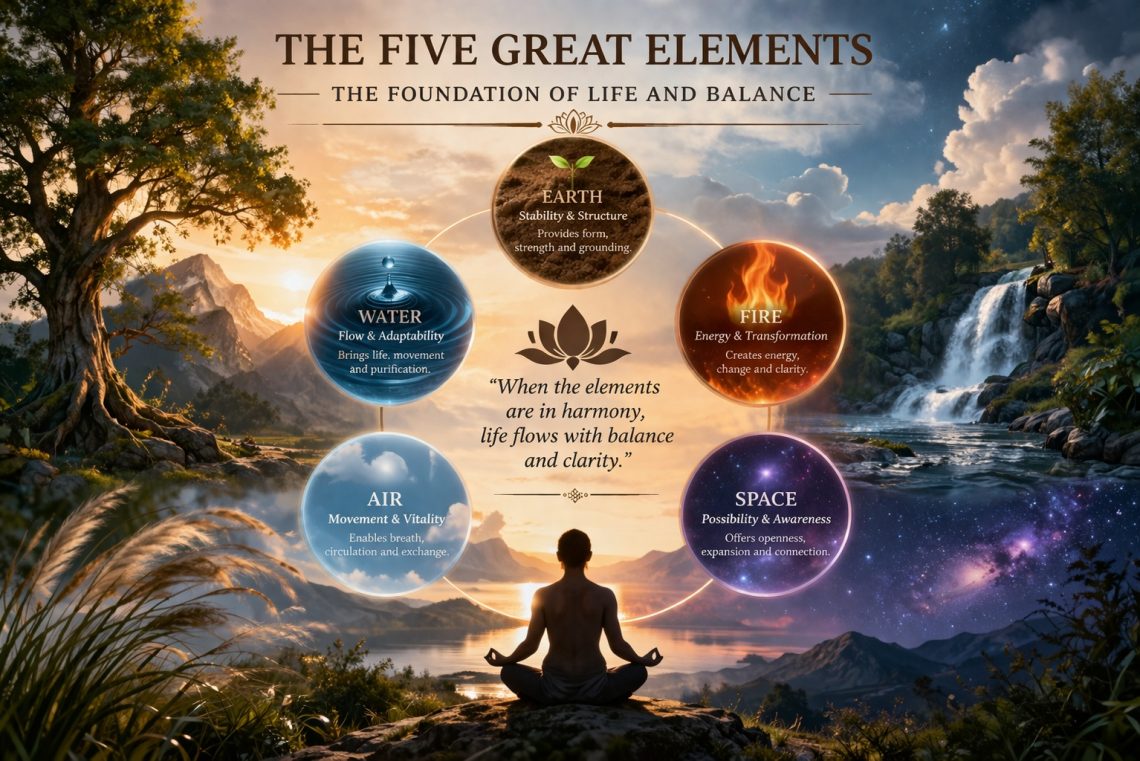
Everything we experience — the body, nature, and even the air we breathe — is built on a few fundamental elements. Ancient wisdom describes these as earth, water, fire, air, and space. Modern science also explains life through matter, energy, and dynamic systems working in balance. When we look closely, both perspectives point toward the same principle — life functions through harmony.
“What exists outside also operates within — life follows the same laws at every level.”
The Five Great Elements of Life Explained
The concept of Panch Mahabhutas provides a structured way to understand life. These elements are interconnected forces that shape the body, influence natural processes, and maintain balance.
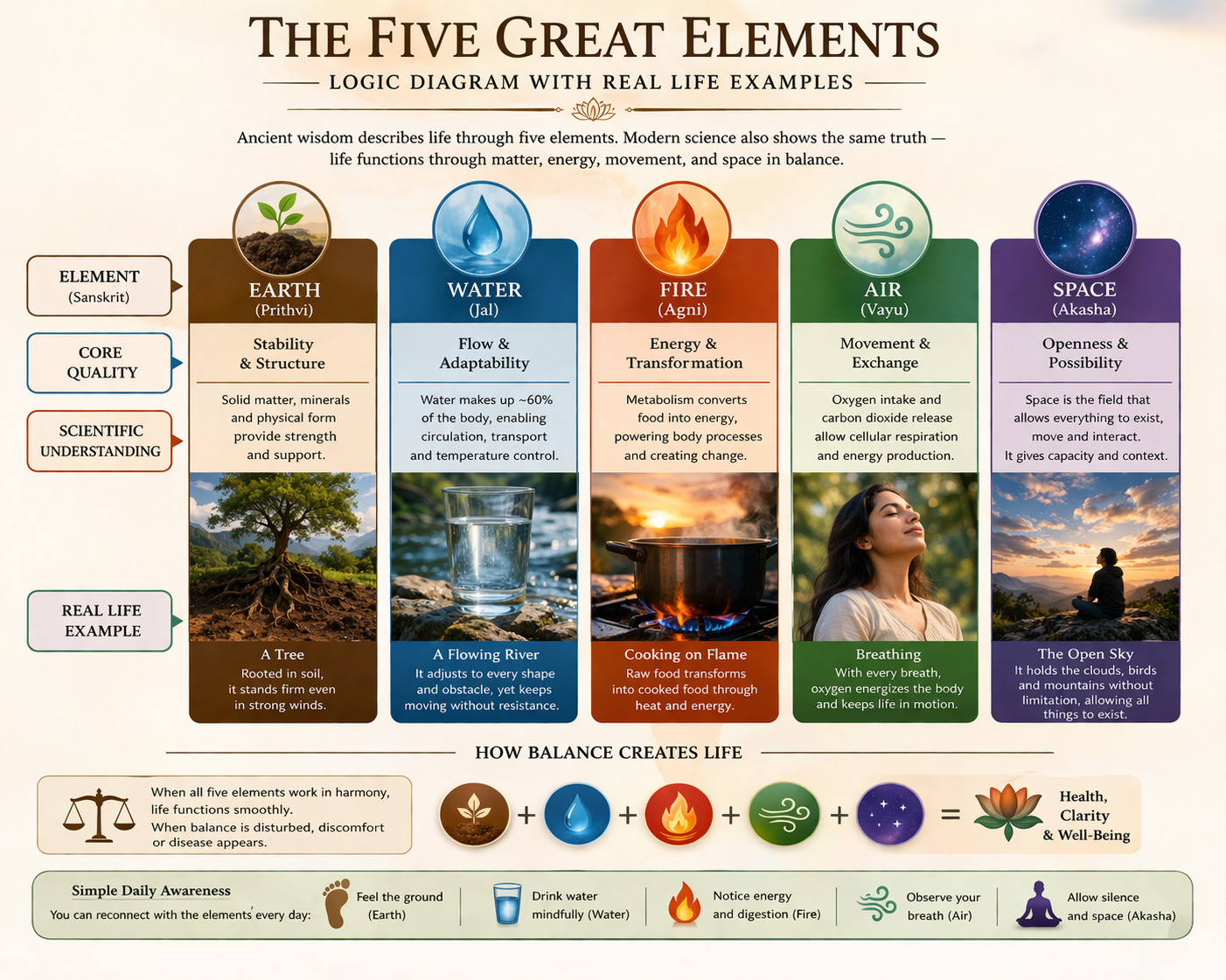
The diagram above shows how each element is not just a concept but a real, observable part of life. From physical structure to energy flow and environmental balance, these elements work together continuously.
Earth (Prithvi): Structure and Stability
Earth represents solidity and structure. In the human body, this includes bones, muscles, and physical form. Scientifically, it relates to minerals and solid matter that provide strength and support.
Without a stable base, no system — whether biological or environmental — can function effectively.
Water (Jal): Flow and Regulation
Water represents fluid balance and movement. Around 60% of the human body is water, making it essential for circulation, temperature control, and nutrient transport.
Systems that adapt and flow are better able to handle change and maintain stability.
Fire (Agni): Energy and Transformation
Fire symbolizes energy and transformation. In scientific terms, this corresponds to metabolism — the process of converting food into usable energy.
Without transformation, energy cannot be utilized, and life processes cannot continue.
Air (Vayu): Movement and Exchange
Air represents movement and gaseous exchange. Oxygen intake and carbon dioxide release support cellular respiration and energy production.
Even small changes in breathing directly influence body function.
Space (Akasha): Capacity and Interaction
Space provides the environment in which all processes occur. Without space, no movement, interaction, or structure would be possible.
It allows systems to exist, expand, and function freely.
The Principle of Balance
Both ancient teachings and modern science emphasize balance. In biology, this is known as homeostasis — the body’s ability to maintain stable internal conditions despite external changes.
When one element becomes dominant or deficient, imbalance occurs, affecting overall functioning.
Life remains stable when its fundamental elements stay in balance.
Practical Observation in Daily Life
These elements are not abstract ideas — they can be observed in everyday life:
- Physical strength and nutrition relate to Earth
- Hydration and circulation relate to Water
- Energy levels and digestion relate to Fire
- Breathing and movement relate to Air
- Awareness and mental space relate to Space
“Observing simple processes reveals how life maintains its balance.”
A Simple Daily Practice
Understanding becomes meaningful when applied. Simple awareness helps reconnect with these elements:
- Notice physical stability and posture (Earth)
- Stay aware of hydration (Water)
- Observe energy and digestion patterns (Fire)
- Pay attention to breathing (Air)
- Allow moments of stillness (Space)
Conclusion
The five great elements provide a logical framework to understand life. They connect ancient philosophy with modern science, showing that life is structured, interconnected, and dependent on balance.
By observing these elements, we gain clarity about how the body functions and how balance can be maintained in daily life.
“When the foundation is understood, balance becomes easier to maintain.”


No Comments